Solar return: your chart for the year from one birthday to the next
A solar return chart captures the moment the Sun returns to its natal degree. Learn how to read it for the year, how a precessed return differs, and which location to use.
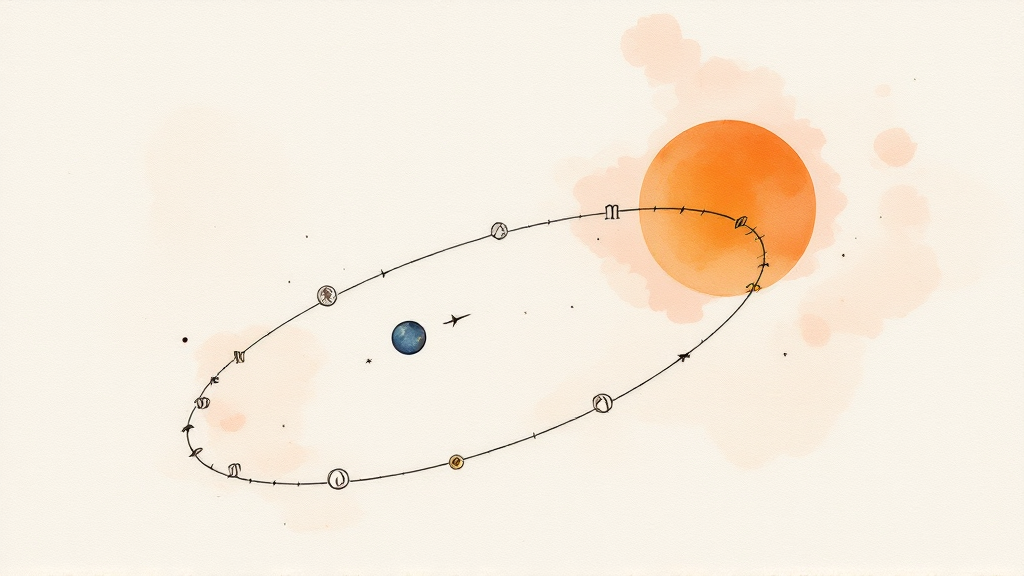
A solar return (from Latin sol, “sun”) is one of the clearest techniques for annual forecasting in astrology. The idea is simple and beautiful: every year the Sun returns to the same point in the Zodiac where it stood at the moment of your birth, and at this moment we draw up a new chart. This chart — the solar return — describes the themes and tone of the next 12 months of your life, from one birthday to the next.
If you are already familiar with the natal chart and have read about transits, the solar return is the next logical tool. It is an “annual natal chart”: with its own ascendant, its own MC, its own houses. We will look at how a solar return is calculated, which location to use, how the precessed version differs and how the chart can be useful.
What is a solar return?
The full name of the technique is Solar Return, “return of the Sun.” This is a chart for the moment when the transiting Sun returns to the exact ecliptic degree, minute and second it occupied at your birth.
The return of the Sun occurs every year, but not always exactly on your birthday according to the calendar. Because the astronomical year is about 365.25 days while a common calendar year has 365 (with leap years correcting the difference), the Sun's exact return may fall on your birthday or a day before or after—usually within 24 hours of that date.
This is important: the solar return chart is not calculated for midnight on your birthday, but for the exact moment when the Sun returns to the natal point. It might occur at 04:17 on March 14 or at 22:48 on March 12 — depending on your natal Sun degree and the exact time.
Solar return vs. a zodiac-sign yearly forecast
When they say “forecast for the year by sign,” that is another average “for all Leos.” A solar return is an individual chart for your specific birthday, with a unique ascendant and arrangement of planets by house. One person’s solar return chart changes greatly from year to year: one year the ascendant is in Cancer, the next in Scorpio. Each such shift is a new “annual role.”
The solar return chart is a symbolic portrait of the year you are about to enter. It does not determine what will happen, but describes how you may experience what happens.
History of the method
The technique of returns has been known since the Hellenistic era. The writings of Vettius Valens (2nd century CE) already described methods in which the main planets — especially the Sun and Moon — were used to construct annual and monthly charts. In Arab astrology of the 8th–12th centuries (Abu Ma’shar, Al-Biruni), the solar return technique acquired a complete form.
In medieval Europe, the solar return was a standard tool for court astrology. Each year, astrologers drew up a return chart for the ruler and used it to describe the main themes of the coming year.
In the 20th century, the technique was renewed. French astrologer Alexander Volgin developed a detailed method for interpreting solar returns, including precessed returns. The Italian astrologer Ciro Discepolo (born 1949) focused on the technique of the “relocated solar return” — building a solar return not for the place of birth, but for the place where a person is actually located at the moment of the return of the Sun. This gave rise to the practice of traveling for a birthday in the hope of changing the year’s emphasis.
How it works
A solar return uses the same ecliptic geometry as a natal chart, and requires three parameters:
- The exact date and time of the Sun’s return — determined by the natal degree of the Sun and ephemerides.
- Location — the geographical point for which the chart is drawn.
- House system — usually the same one used for the natal chart.
The resulting chart is read as an independent “horoscope of the year”: with its own ascendant, MC and planetary placements by house.
Which location should you use: birthplace or residence?
This is one of the most common questions for newcomers and a long-standing debate between schools.
- Solar return for the birthplace — classical school. It is believed that the place of birth is your “astrological anchor,” and the solar return chart is always calculated there.
- Solar return for your current residence — a more common modern approach. The chart is calculated at the coordinates of the place where you actually live at the time of the return of the Sun.
- Relocated solar return — Ciro Discepolo advocated traveling to another city or country a few days before your birthday to obtain a “better” solar return ascendant and MC. This practice is popular among experienced practitioners.
In many established schools today, the solar return is calculated for the place where you actually are at the moment of the return of the Sun. If you have moved, the chart is calculated for the new city. This gives a forecast more closely tied to your circumstances.
Precessed solar return
This is where the astronomy becomes more nuanced. Earth’s axis slowly shifts — this phenomenon is called precession of the equinoxes, discovered by Hipparchus in the 2nd century BCE. Due to precession, the apparent point of the vernal equinox moves slowly along the ecliptic at a rate of approximately 1° every 72 years.
The tropical zodiac, as used in Western astrology, is tied to the vernal equinox — that is, it “moves” with precession. The sidereal zodiac is tied to the stars and is treated as stationary in this comparison.
A precessed solar return is an attempt to take into account precession: the return is calculated to the natal Sun degree adjusted for precession (about 1 minute per year). The adjustment is small, but it shifts the exact time of return by several hours — and therefore the solar return ascendant.
Supporters of precessed solar returns (for example, Discepolo) believe that it is more accurate. Supporters of the classical version say that precession is already taken into account by the nature of the tropical zodiac. In practice, experienced astrologers sometimes compare both options and see which one better reflects events in their past years.
On astronavi you can choose how to calculate a solar return: classical, precessed, for your birthplace or for your current residence. If you are new to the technique, start with a classical return calculated for your current residence — this is the most universal option.
When a solar return is considered active
A solar return is read as active from the exact moment of the return of the Sun until the next similar moment, that is, one tropical year (365 days 5 hours 48 minutes 46 seconds). Within this year, the solar return chart provides the main “backdrop” of the forecast.
Solar returns and transits serve different purposes: the return chart sets the “annual temperature,” and specific events are tied to transits and progressions that activate the solar return themes.
What your solar return shows
A solar return is read on three levels.
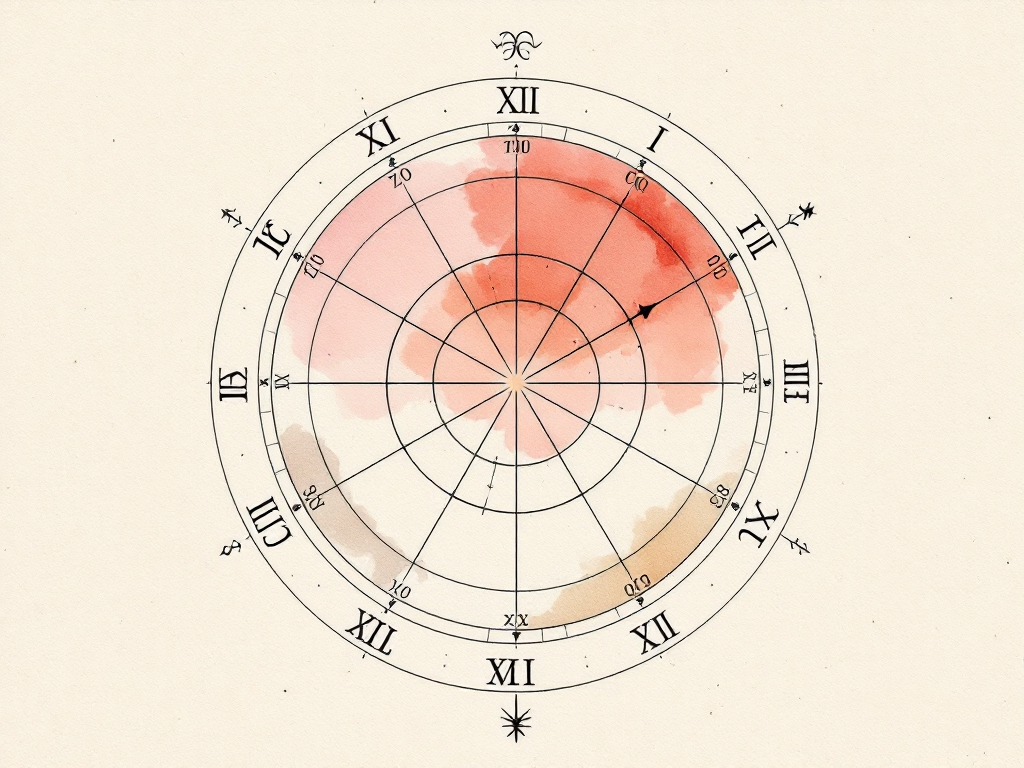
Level 1. Solar return ascendant and MC
These are the two main angles of the solar return chart, and they set the “face of the year.”
- Solar return ascendant — the role you take during the year, how you see yourself and how others see you.
- Solar return MC — the year’s public and career themes and the main direction of social activity.
For example, the solar return ascendant in Cancer + MC in Aries is a year when you feel drawn toward home and family but act decisively in public life (often moving, settling down, starting a new family stage).
Level 2. The solar return Sun’s house
This is perhaps the main quick marker of the year. The solar return Sun always stands at the same degree of the Zodiac as in the natal chart, but at the same time it falls into different houses of the return chart — and the house points to the year’s main area of focus.
- Sun in the 1st house of the solar return chart — a year of personal reboot, self-assertion, physical changes (appearance, fitness).
- Sun in the 2nd house — a year focused on finances, with money and resources coming to the fore.
- Sun in the 3rd — learning, communication, inner circle, short trips.
- Sun in the 4th — home, family, settling in, sometimes moving.
- Sun in the 5th — creativity, romance, children, pleasure.
- Sun in the 6th — work, routine, health, skills.
- Sun in the 7th — partnership, relationship, sometimes marriage or divorce.
- Sun in the 8th — deep changes, crisis, other people's resources, inheritances.
- Sun in the 9th — worldview, long trips, study, migration.
- Sun in the 10th — career year, visibility, status.
- Sun in the 11th — friends, communities, goals, projects.
- Sun in the 12th — a year of solitude, inner work, sometimes leaving an old stage.
Level 3. Stelliums and aspects
Next, look at which solar return house contains the most planets (a stellium): this is the year’s “hot spot.” Also examine aspects between return-chart and natal planets; conjunctions between them often mark significant themes of the year.
When a solar return can help
- Before a birthday — a useful time to analyze the solar return. You get an overview of the year ahead and can plan around the chart’s themes.
- When choosing a place of residence — if you are considering moving, you can compare solar return charts for different cities and understand in which of them the “annual climate” better suits your goals.
- For planning a birthday vacation — a relocated solar return allows you to consciously choose the place of celebration in order to get a desired ascendant or a desired Sun house.
Common myths and mistakes
Myth 1. “The solar return fixes the year’s fate; nothing can change.” A solar return is a symbolic chart of the year’s themes and tone. Specific events depend on your choices, environment, and other forecasting layers. It describes the climate, not a fixed script.
Myth 2. “Traveling for your birthday can ‘rewrite’ your destiny.” A relocated solar return does give a different chart for the year, but this is a shift in emphasis, not a replacement for the natal chart. The natal chart remains the main foundation, the solar return works on top of it.
Myth 3. “Only the precessed solar return is correct.” Astrological schools differ on this. Experienced astrologers know examples where the classical chart fits better, and others where the precessed chart does. It makes sense to compare both options against your past years.
Myth 4. “A solar return replaces transits and progressions.” No, these are different layers of forecasting. A solar return provides the annual background. Transits help describe specific events and their timing. Progressions are the internal maturation of themes. An in-depth annual forecast uses all three.
Do not make major life decisions based on a solar return alone. The return chart is a useful tool, but it requires context: the natal chart, progressions, transits and your real situation. If there is a “threatening” aspect to the solar return, this is almost always a topic for elaboration, not a reason for fear.
On astronavi, the solar return chart is calculated using the Swiss Ephemeris with arcsecond-level accuracy, at the time of the true return of the Sun. You can choose the type of calculation: classic, precessed, at the place of birth or current residence. The forecast is written personally for your chart: with an analysis of the solar return ascendant and MC, the house of the solar return Sun, stelliums and connections to the natal chart. If you want to get a clear portrait of the coming year, calculate your solar return on the practice page.
Questions and answers
What is a solar return in astrology in simple terms?+
It is a chart for the moment when the Sun returns to the same zodiac position it occupied at your birth. That chart describes the themes and tone of the coming year, from one birthday to the next.
Does a solar return happen exactly on my birthday?+
Not always. The precise return may fall on your birthday or a day before or after, depending on your natal Sun position and the calendar cycle. The chart is calculated for the exact moment of return.
Which location should I use for a solar return: birthplace or current location?+
Many modern schools use the coordinates of where you actually are when the Sun returns. If you have moved, they calculate the chart for your new city. The classical school uses your birthplace.
What is a precessed solar return, and do I need one?+
It is a solar return adjusted for precession of the equinoxes, the slow shift in Earth’s axis. The adjustment is small but may move the exact return time by several hours and change the return chart’s ascendant. Which version fits better is a matter of astrological school and reviewing your past years.
What does the solar return ascendant show?+
It is the “face” of the year: the role you take, how you see yourself and how others see you. It changes from one return chart to the next and may noticeably change your style of life.
Can traveling for my birthday “improve” the year?+
A relocated solar return produces a different yearly chart, and some astrologers use it to shift the year’s emphasis. But it adds a layer to the natal chart; it cannot erase that foundation or “reset fate.”
Does a solar return replace transits and progressions?+
No. The solar return describes the year’s background, transits help with events and timing, and progressions describe the inner development of themes. An in-depth annual forecast uses all three together.
Ready to try Solar return for yourself?
Open this area in your dashboard for a reading based on your details.