Sky calendar: the week’s main astrological aspects
The sky calendar describes a shared backdrop, rather than a personal horoscope: new and full moons, eclipses and planetary conjunctions that occur for everyone.
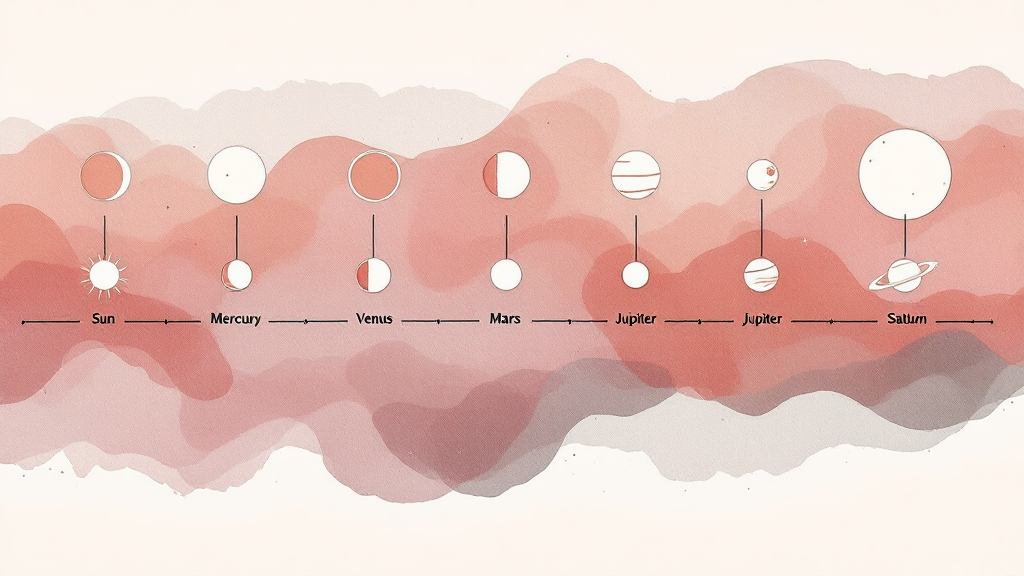
When you open an astrology website and see “Mercury retrograde from this date to that date” or “full moon in Scorpio” — this is a sky calendar. It is not personal. It is shared by everyone. Yet it helps describe the general atmosphere in which your personal story unfolds — and therefore it makes sense to read it, even if you are skeptical of personal horoscopes.
In this article, we will look at what shared astrological events are, which of them are the most significant, how the sky calendar differs from personal transits, and how to practically use it without esoteric fanaticism.
What is the sky calendar
The sky calendar is a table of astronomical events: phases of the Moon, aspects between planets, ingresses (entry of a planet into a new sign), eclipses, conjunctions, retrograde periods. They all occur in the sky objectively and at the same time for everyone.
This fundamentally distinguishes the sky calendar from the two other layers of astrology:
- Natal chart — your personal birth chart; everyone has their own.
- Transits — current planetary positions in relation to your natal chart; these are personal too.
- Sky calendar — what happens in the sky regardless of any one person.
When a news headline says “new moon in Aries will recharge everyone with new energy,” it’s a sky calendar. When an astrologer says “Saturn is now moving across your natal Sun,” this is a transit. These layers overlap rather than contradict one another.
The key point: the sky calendar describes the weather, not your day. The full moon in Scorpio is an atmosphere in which some people are having a difficult conversation, others are completing a project, and others are sleeping peacefully. The atmosphere sets the quality, but does not predetermine the content.
Main collective events
Not all events in the sky are equally significant. There is a hierarchy — from daily small aspects to once-every-several-year conjunctions of slow planets that form eras.
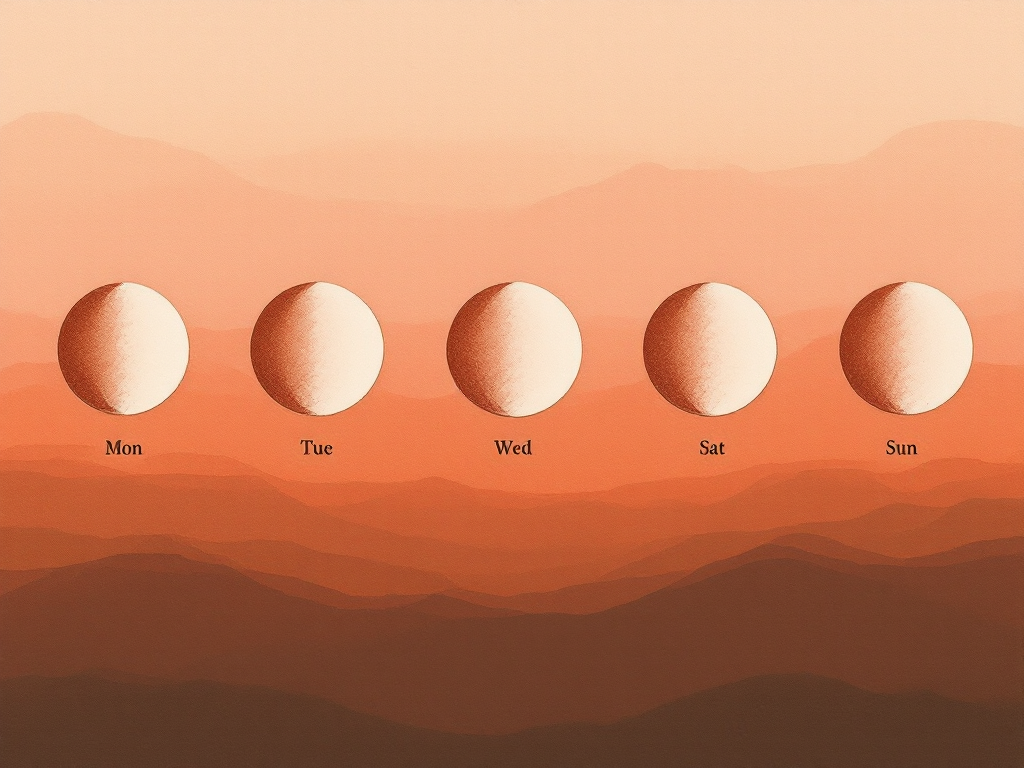
New moon
Conjunction of the Sun and Moon. It occurs about once every 29.5 days. This is the beginning of a new lunar cycle — a traditional starting point: for intentions, for starting things up, for changing the rhythm. Astrologers interpret each new moon according to its sign: the new moon in Capricorn is about discipline and long-term projects, the new moon in Cancer is about home and family.
Full moon
Opposition of the Sun and Moon. About 14 days after the new moon. This is the peak of the cycle, the moment of culmination: what was launched on the new moon manifests itself to the maximum. Full moons are often described as emotionally charged days — this is an empirical observation, not a superstition. Studies of sleep (e.g., meta-analysis by Cajochen et al., 2013) document small but statistically significant variations in sleep quality around the full moon.
Eclipses
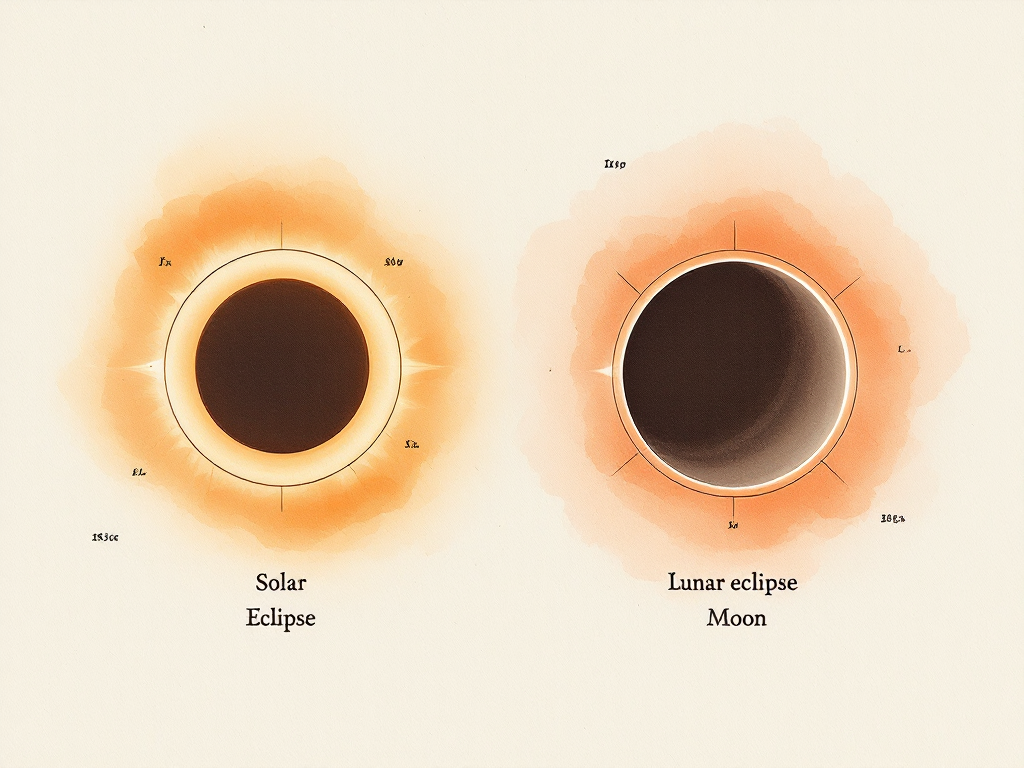
A special type of new and full moon, when the Sun, Moon and Earth line up near the nodes of the lunar orbit. A solar eclipse is an intensified new moon, a lunar eclipse is an intensified full moon.
In astrology, eclipses are treated as especially significant shared events. Their influence is traditionally read as extending for 6 months ahead (until the next eclipse at the same point) and appears not only on the eclipse day, but in waves — at the moments when fast planets activate its degree.
In 2026, there are two solar and two lunar eclipses — the standard annual set. Their dates are available in ephemeris tables years in advance.
Conjunctions of slow planets
The most significant events in the sky calendar are the conjunctions of Jupiter, Saturn, Uranus, Neptune and Pluto with each other. They occur rarely (some occur once every 14, 20, 30 or more years) and are considered markers of eras.
- Jupiter–Saturn (once every ~20 years) — a change in social cycles and economic paradigms. The last conjunction was in December 2020 in Aquarius.
- Saturn–Uranus — crises and revolutions, the collision of old and new.
- Uranus–Neptune (once every ~172 years) — fundamental shifts in worldview.
- Uranus–Pluto — social upheaval. Their 2012–2015 square coincided with the Arab Spring and a series of global crises.
These events do not “happen to you personally” — they describe a historical era. But they are the ones that describe the world in which your private life unfolds.
Retrograde periods
The period when a planet appears to move backward in the zodiac (this is an optical effect of the relative speed of the Earth and the planet). The most famous is Mercury retrograde, which occurs 3-4 times a year for ~3 weeks.
Pop astrology greatly exaggerates the significance of Mercury retrograde. A more measured astrological interpretation treats it as a period of review, completion and returning to unfinished business. There is nothing catastrophic about it — planes do not crash more often and contracts are not canceled en masse. Astrologers may suggest planning important new projects during direct motion and using retrograde weeks for revisions.
Planetary ingresses
The planet enters a new sign. For slow planets (Jupiter once a year, Saturn once every 2.5 years, Uranus once every 7 years) this is a significant event — the social atmosphere takes on a new tone. For example, Pluto's transit into Aquarius in 2024 marks a ~20-year cycle colored by themes of technology, collectives, and redistribution.
Sky calendar vs personal transits
These are two different layers, and confusing them is the main mistake of readers of astrology columns.
| Parameter | Sky calendar | Transits |
|---|---|---|
| Audience | Everyone | You personally |
| Reference point | The sky itself | Your natal chart |
| Example | "Full Moon in Aries on October 6" | “Transiting Saturn trine natal Sun” |
| Strength of effect | The same for everyone | Depends on the natal point involved |
| Main use | Shared atmosphere | Personal themes for the period |
The same day can be “loud” in the sky calendar (for example, an eclipse) and yet not affect your natal chart at all — if the degree of the eclipse is far from the sensitive points of your horoscope. And vice versa: a quiet day in the sky can be huge for you personally, because transiting Jupiter is in an exact trine to your MC today.
Astrology is the language of cycles. To read life, you need to simultaneously hear the rhythm of your own horoscope and the rhythm of the world in which this horoscope is placed.
Therefore, the correct reading of astrology is two-layered: we read the sky calendar as weather and place our own chart within it.
How to read a weekly calendar
A practical algorithm for using the weekly sky calendar without overload.
1. Mark major events. If there is a new moon, full moon, planetary ingress or eclipse in the week, these are anchor points. The rest is background.
2. Look at which sign. The sign colors the event. The Full Moon in Cancer is about home and emotions. The Full Moon in Capricorn is about work and commitments. The New Moon in Gemini is about communication and learning.
3. Consider fast aspects. On the same day of the full moon there may be an exact square Mars–Uranus. This adds a touch: impulsiveness, surprise. Without this layer the picture is flat.
4. Don’t mix it with the personal. If you want to understand exactly how this week will affect you, you need transits to your natal chart. The sky calendar itself will not provide a personal forecast.
5. Take extra care on the most “stormy” days. If an eclipse, an exact square and stationary Mercury coincide, common sense may suggest postponing the signing of a home purchase agreement. Do not make this an absolute rule: thousands of people sign contracts on any given day and live happily.
Common myths
“Mercury Retrograde is a disaster.” Not a disaster. This is a period when it is worth checking correspondence more carefully, allowing extra time for travel and not rushing into large new contracts. That is all. Planes do not crash, trains run on schedule, technology works.
“The full moon drives people crazy.” The saying about “lunatics” (from luna) is a popular exaggeration. Meta-analyses of psychiatric hospitalization find no correlation with moon phase. What is confirmed is a slight effect on sleep and the menstrual cycle, but the effects are modest and individual.
“You can’t watch an eclipse, it’s charged with negativity.” You can’t watch a solar eclipse without special glasses — this is a matter of eye physiology, not astrology. Astrologically, eclipses are powerful but neutral events: they activate themes that were overdue anyway.
“If all the planets are retrograde, the world will freeze.” On average, 4–5 planets are simultaneously retrograde during certain periods of the year, and nothing global happens. This is a normal astronomical pattern.
Who benefits from the sky calendar
— For those who are planning big steps — launches, releases, moves — and want to take into account the background. — For people running communication and media projects: the atmosphere of a full moon or eclipse greatly influences the public response. — For those who track their cycles (sleep, productivity, emotional swings) and notice correlations with the lunar phases. — For those just curious, this is a beautiful way to feel the rhythm of time and not live in the illusion that every day is the same.
In astronavi sky calendar shows all the main collective events for the week and month ahead: phases of the Moon, ingresses, exact aspects of slow planets, eclipses and retrograde periods — calculated using the Swiss Ephemeris. This is the atmosphere of the era in which you write your personal history.
Questions and answers
How does the sky calendar differ from a horoscope?+
A sky calendar lists astronomical events shared by everyone, such as Moon phases, planetary aspects and eclipses. A personal horoscope also considers your natal chart and how those events relate to it. The calendar describes a common backdrop; a horoscope interprets your experience within it.
How many eclipses happen in a year?+
Usually four: two solar and two lunar. Some years have five to seven. Exact dates are available in ephemerides years in advance.
Should I be afraid of Mercury retrograde?+
No. It is a normal astronomical period, occurring about three times a year for roughly three weeks, that astrologers associate with review, completion and unfinished business. Popular astrology often exaggerates its effects. Allow extra time for communication and check important plans without treating the period as a disaster.
How might a full moon affect well-being?+
The article cites studies reporting a small difference in sleep quality around the full moon (Cajochen et al., 2013). Links with emotional states are less clear and may reflect expectation. People respond differently to the full moon’s peak atmosphere.
Which matters more: the sky calendar or my personal horoscope?+
They are two layers of one picture. The sky calendar describes the general backdrop; a personal horoscope considers how it relates to your natal chart. Astrologers read them together rather than ranking one above the other.
Can I plan important activities using the sky calendar?+
You can use it as one factor. Some astrologers favor beginnings during the waxing Moon and avoid tense slow-planet aspects, but people make sound decisions on every kind of day. Treat the calendar as a guide, not a rigid schedule.
What is a Jupiter–Saturn conjunction?+
It is a meeting of the two planets at the same zodiac degree, occurring about every 20 years. Astrologers associate it with shifts in social and economic cycles. Their December 2020 conjunction in Aquarius began a roughly 200-year “air” cycle in this tradition, associated with technology, information and horizontal networks.
Ready to try Sky calendar for yourself?
Open this area in your dashboard for a reading based on your details.