Three-rune spread: past, present and future in one story
Explore the 24 runes of the Elder Futhark, an ancient Germanic alphabet and a modern reflection tool. Learn to read a past–present–future spread, consider each rune’s symbolism and build a story rather than a prediction.
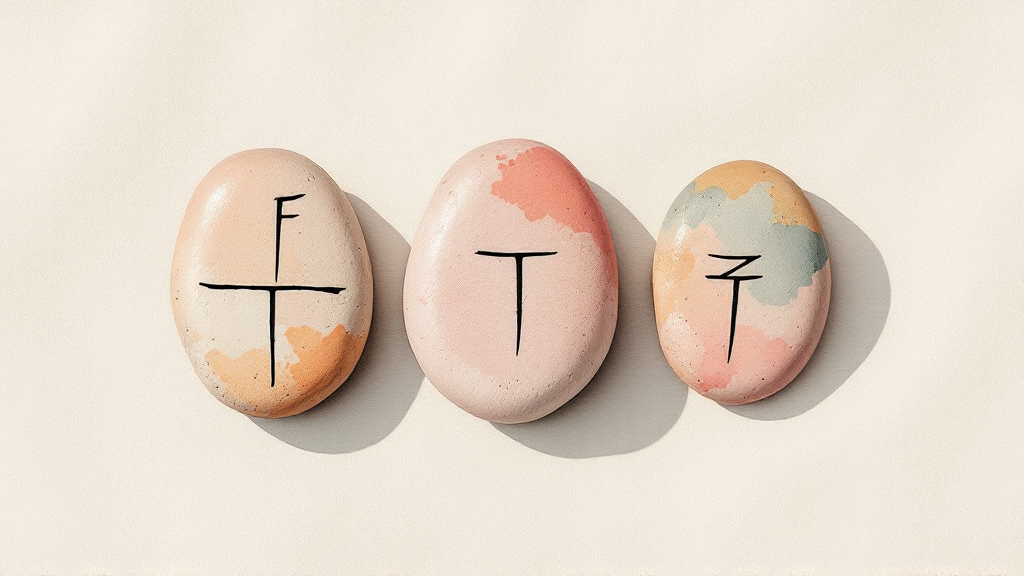
The runes familiar from television were once part of an ancient alphabet that Germanic peoples used for nearly 1,500 years: from inscriptions on weapons and amulets to lines on gravestones. A three-rune spread offers a simple, grounded way to work with these symbols today: you draw three signs for “past - present - future” and build a short story from them about your situation. A story, not a prediction. Below we explore the Elder Futhark, where it came from, how to read a three-rune spread and where the limits of practice are.
What are runes and the three-rune spread
Runes are characters in ancient Germanic writing. Each rune can be understood as a
- letter representing a speech sound;
- word or concept (for example, Fehu = “cattle” or “property”);
- symbol with a set of traditional associations.
The most famous runic alphabet is Elder Futhark, which consists of 24 runes. The name “futhark” comes from the first six runes: F-U-Th-A-R-K. The alphabet is divided into three ættir of 8 runes each, traditionally called the “families” of Freyr, Heimdall and Tyr.
| Ætt | Runes (1–8) |
|---|---|
| Freyr | Fehu, Uruz, Thurisaz, Ansuz, Raido, Kenaz, Gebo, Wunjo |
| Heimdall | Hagalaz, Nauthiz, Isa, Jera, Eihwaz, Perthro, Algiz, Sowilo |
| Tyr | Tiwaz, Berkano, Ehwaz, Mannaz, Laguz, Ingwaz, Dagaz, Othala |
The three-rune spread is a concise way to work with this set. You draw three runes and arrange them from left to right:
- Past / origins - how the situation began, what shaped it.
- Present / essence - what is the main thing in it now, what is the focus.
- Future/Trend - where the current direction may lead.
The key word is trend, not “prediction.” The third rune shows where today’s vector leads, and not “what will happen for sure.” You can change the vector and the story can change.
Runes are an interpretive framework. They do not “know the future”; they provide a language through which it is convenient to talk about one’s own situation. The most valuable part of the spread is not the meanings of the runes themselves, but your reaction to them.
History: from Germanic inscriptions to the Edda
The Elder Futhark appeared around the 1st–2nd centuries CE among the Germanic tribes of Northern and Central Europe. The earliest reliably dated finds are short inscriptions on weapons, brooches, combs and amulets. Among the most famous artifacts:
- Negau helmet (Austria, c. 2nd century BCE) - controversial, but mentioned as one of the early candidates for proto-Futhark.
- Vimose comb (Denmark, c. 160 CE) - "harja" inscription, one of the earliest reliably read.
- Einang stone (Norway, 4th century) - runic memorial.
Runes were carved on wood, bone and metal, and later on stones. The famous rune stones of Sweden, Denmark and Norway (especially the 8th–11th centuries) are already the era of the Younger Futhark, when the alphabet was reduced to 16 characters for the Scandinavian languages of the Viking Age.
In literary sources, runes are mentioned in the Poetic Edda and Prose Edda (written down in the 13th century, but preserving earlier material). In the “Sayings of the High One” (Hávamál) there is a famous episode where Odin, hanging from the ash tree Yggdrasil for nine nights, obtains the knowledge of the runes:
I know that I hung on a windswept tree for nine long nights, pierced by a spear and dedicated to Odin, myself offered to myself, on a tree whose roots reach into the unknown.
This plot is mythological, but it shows the importance that northern culture attached to runes: signs are not only writing, but also a form of knowledge gained through ordeal.
With the advent of Christianity (9th–12th centuries in Scandinavia), runes were gradually replaced by the Latin alphabet, although in some regions - especially in Swedish Dalecarlia - runic signs were used in everyday life until the 19th century.
Important clarification. The use of runes as a system of divination in the modern sense is largely a reconstruction of the 20th century. We have the Roman historian Tacitus who, in his Germania (98 CE), describes the practice of drawing lots with notched sticks - but without directly indicating that these notches were runic. Modern “spreads” are a synthesis of historical fragments and a system that was popularized in the 1980s by, among others, Ralph Blum in The Book of Runes (1982). Blum added a “blank rune” (Wyrd), which is absent from the historical Futhark; it was his own innovation.
The honest conclusion is that the three-rune spread is a modern meditative practice with a historical basis, not “ancient Viking magic.” There is nothing wrong with that, as long as the distinction stays clear.
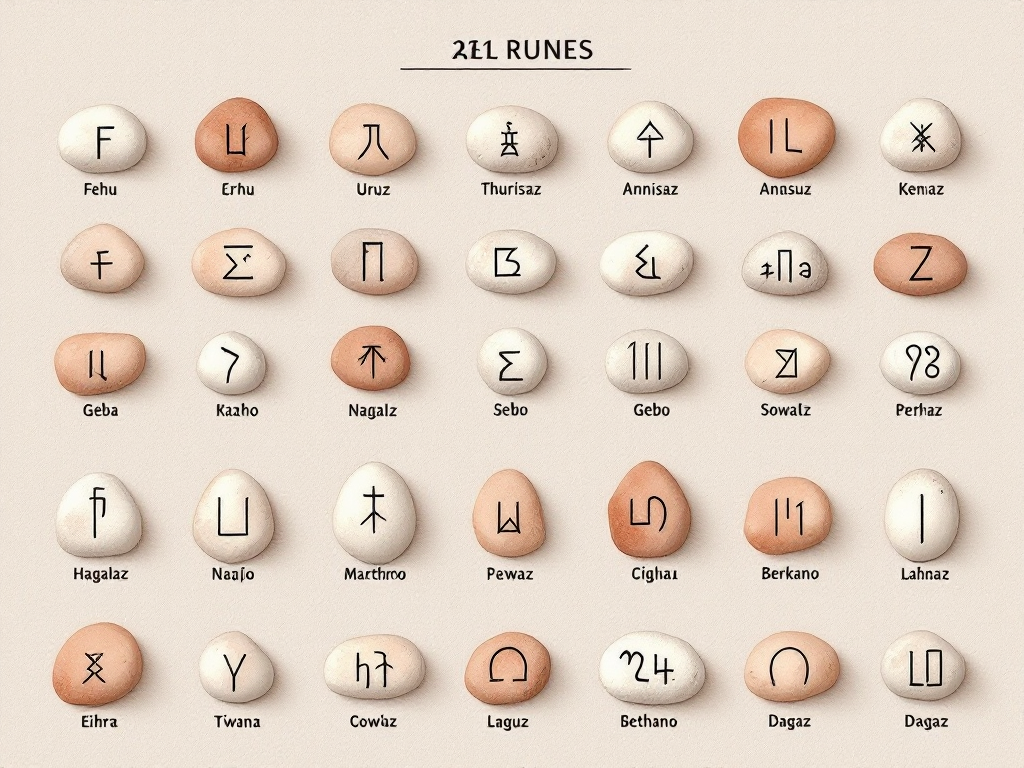
How it works: 24 runes and their short meanings
Below is a compact table of the 24 Elder Futhark runes. These are not definitive meanings, but an interpretation common in modern practices. Different authors’ approaches (Blum, Thorsson, Austin) may emphasize different aspects.
| No. | Rune | Name | Direct meaning | Topic |
|---|---|---|---|---|
| 1 | ᚠ | Fehu (Feu) | "cattle", property | Resources, income, material support |
| 2 | ᚢ | Uruz | “bison”, untamed strength | Health, bodily strength, instinct |
| 3 | ᚦ | Thurisaz | “giant”, thorn | Obstacle, collision, protection |
| 4 | ᚨ | Ansuz | “god” (Odin) | Word, message, clarity of speech |
| 5 | ᚱ | Raido | "riding", path | Travel, movement, rhythm |
| 6 | ᚲ | Kenaz | "torch" | Knowledge, clarity, creative fire |
| 7 | ᚷ | Gebo | "gift" | Exchange, relationships, partnerships |
| 8 | ᚹ | Wunjo (Vinye) | "joy" | Harmony, satisfaction, well-being |
| 9 | ᚺ | Hagalaz | "hail" | Sudden disruption, destruction → renewal |
| 10 | ᚾ | Nauthiz | "need" | Limitation, necessity, endurance |
| 11 | ᛁ | Isa | "ice" | Pause, freeze, rest |
| 12 | ᛃ | Jera | "year", harvest | Cycle, fruits, timeliness |
| 13 | ᛇ | Eihwaz | “yew” | Axis, grounding, endurance |
| 14 | ᛈ | Perthro (Perth) | "lot" | Mystery, hidden, birth |
| 15 | ᛉ | Algiz | “elk”, protection | Border, amulet, vigilance |
| 16 | ᛋ | Sowilo (Soulu) | "sun" | Strength, clarity of purpose, success |
| 17 | ᛏ | Tiwaz (Teyvaz) | god Tyr | Justice, courage, choice |
| 18 | ᛒ | Berkano (Berkana) | "birch" | Growth, care, new beginnings |
| 19 | ᛖ | Ehwaz (Evaz) | "horse" | Partnership, moving together |
| 20 | ᛗ | Mannaz | "person" | Self-perception, identity, society |
| 21 | ᛚ | Laguz | "water" | Feelings, flow, intuition |
| 22 | ᛜ | Ingwaz (Ingvaz) | god Ing | Grain, potential, completeness |
| 23 | ᛞ | Dagaz | "day" | Breakthrough, clarity, turning point |
| 24 | ᛟ | Othala (Odal) | "inheritance", "homeland" | Roots, home, continuity |
How to make a spread
- Formulate a question. Not “yes/no”, but open-ended: “What is important to see in this situation?”, “What is driving my choice now?”, “What am I missing?”
- Shuffle the runes. Shuffle a physical set in a bag, or use the online “Draw” button.
- Draw three runes from left to right.
- Read each one separately in its position:
- The past is what you received at the start of this story. - The present is where the focus is now. - The future is where the current path may lead.
- Connect into one phrase. This is the central step. For example: “From Raido (movement, change) I came to Isa (pause, freeze), and with the current direction this leads to Dagaz (breakthrough).” The story suggests that the pause is temporary and may be part of a path toward clarity.
- Write 3–5 sentences in your journal. What resonated? What do you want to argue with? What did you already know without runes?
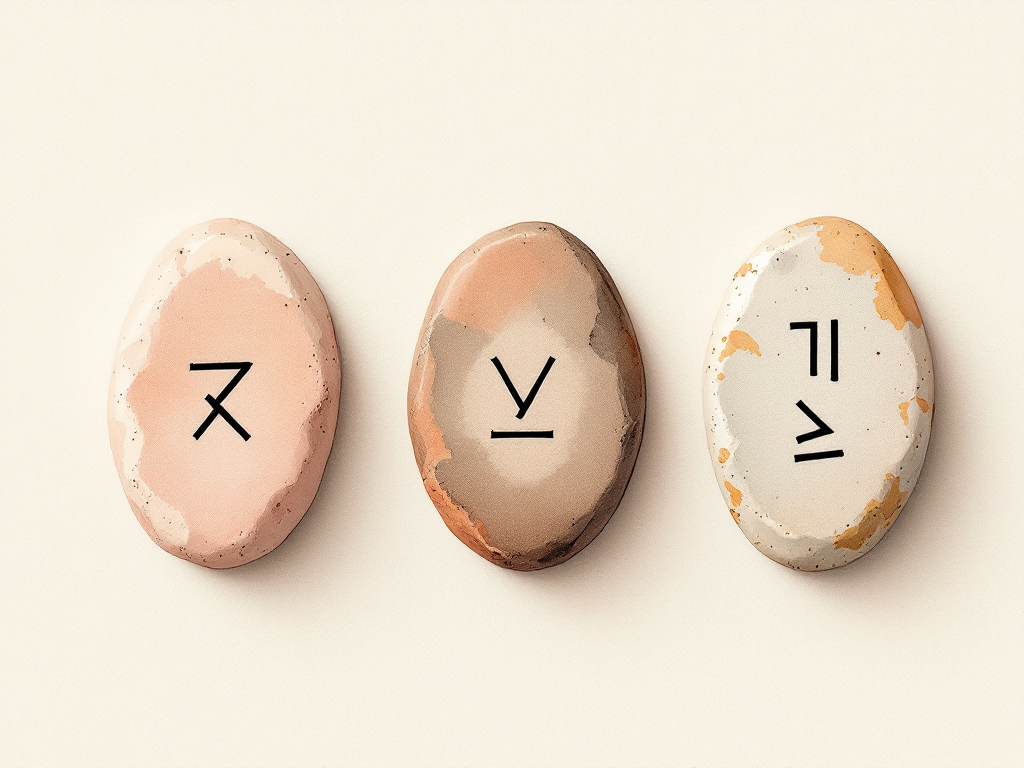
What does the three-rune spread show you?
The value of the spread is not in the “accuracy of a prediction”. It is in three specific things:
- Structure. Most life situations do not have a clear composition - there is a mess of thoughts and feelings. Three positions (past, present, future) give structure: where is the beginning, where is now, where is it going.
- Metaphor as another route. Direct question “what should I do?” often ends up in the same mental rut in which you have been for a month. The metaphor (“Hagalaz—hail, sudden disruption”) offers a detour through which you can often see what is not visible directly.
- Your reaction as material. The most informative moment is your first feeling when you see the rune. “I don’t like it” - why exactly? “Relief” - what does this say about your actual answer? This reaction is the main asset of the session, not the meaning in the table.
What the spread doesn't do:
- Does not answer yes/no. If you pulled out Dagaz on “will I get married” - this is not “yes”. This “is a theme of clarity and a turning point,” and it’s up to you to think further.
- Does not predict events with accuracy. The third rune suggests a trend, not a fixed scenario.
- Does not provide medical, legal or financial solutions. There are specialists for them.
Myths and limitations
Myth 1: “Inverted runes are always negative.” Not all runes have an “inverted” position: Isa, Gebo, Eihwaz, Jera, Sowilo, Dagaz, Ingwaz are symmetrical and do not “invert.” In different schools, upside-down reading is either taken into account or ignored. The main thing is consistency.
Myth 2: “Hagalaz = disaster”, “Thurisaz = trouble.” This is a simplification. Hagalaz is about a destructive process that often cleanses the soil; Thurisaz is about a collision, which can also be a defense. The context of the question is always more important than the minus sign.
Myth 3: “Runes are associated with some kind of ideologies.” Unfortunately, in the 20th century, some far-right groups appropriated some runic symbols (especially Sowilo/Soulu and Odal). This has no relation to the historical Elder Futhark or its cultural heritage. You can use runes as a tool of reflection in a completely neutral way.
Myth 4: “There is one “correct” system of meaning.” No. Modern interpretations are a synthesis of historical sources and the schools of 20th-century authors. Any interpretation is a working model, not the truth.
If you begin to base important life decisions solely on rune spreads, take a break. A rune spread is useful as an addition to your own thinking, and not as a replacement for it. If the situation requires advice, talk to a person you trust.
In astronavi, the three-rune spread is built in so that you receive a story rather than a fixed verdict: three runes, a short meaning of each, and a connecting phrase in our tone - without “a long road awaits you.” If you want to try it without purchasing a physical set, this is a convenient entry into the practice.
Open Three-rune spread, ask your question - and see what short story the Elder Futhark can help you put together from your “past - present - future” today.
Questions and answers
How many runes are in the Elder Futhark?+
The Elder Futhark has 24 runes arranged in three ættir of 8: the ætt of Freyr, the ætt of Heimdall and the ætt of Tyr. “Futhark” comes from the first six runes in the sequence: F-U-Th-A-R-K.
What is a three-rune spread?+
Draw three runes and place them from left to right as past (origins), present (essence) and future (trend). Read each rune in its position, then bring them together into a short story.
Are runes ancient magic?+
The Elder Futhark is a historical Germanic alphabet used from the 1st to 9th centuries for inscriptions on weapons, amulets and stones. Modern rune divination is largely a 20th-century reconstruction associated with Ralph Blum and others. A three-rune spread is a meditative practice with a historical basis, not “Viking magic.”
Can I ask the runes a yes-or-no question?+
A three-rune spread is poorly suited to closed questions. Try an open one instead: “What matters in this situation?”, “What is the focus now?” or “Where might this be going?” The runes then offer metaphors that help structure reflection.
Does Hagalaz always mean something bad?+
No. Hagalaz, meaning “hail,” symbolizes a sudden disruptive process that may clear the way for something new. In a spread it may suggest a crisis followed by clarity. The Elder Futhark has no unambiguously “bad” runes, only runes with difficult themes.
How does the Elder Futhark differ from the Younger Futhark?+
The Elder Futhark has 24 runes and was a common Germanic alphabet from the 1st to 8th centuries. The Younger Futhark has 16 runes and was a Scandinavian adaptation for Old Norse speech from the 8th to 12th centuries. Modern spreads more often use the Elder Futhark for its broader set of symbols.
Should I read reversed runes?+
That depends on your approach. Some runes—Isa, Gebo, Eihwaz, Jera, Sowilo, Dagaz and Ingwaz—are symmetrical and have no reversed position. Some readers treat a reversal as a “weakened” meaning, while others ignore it. Consistency matters more than the choice of school.
Ready to try Three-rune spread for yourself?
Open this area in your dashboard for a reading based on your details.