Natal chart online: what it is, how to read it and why to create one
A natal chart is a snapshot of the sky at the moment of your birth. Learn how to read houses, planets and aspects, and how it differs from a standard zodiac-sign horoscope.
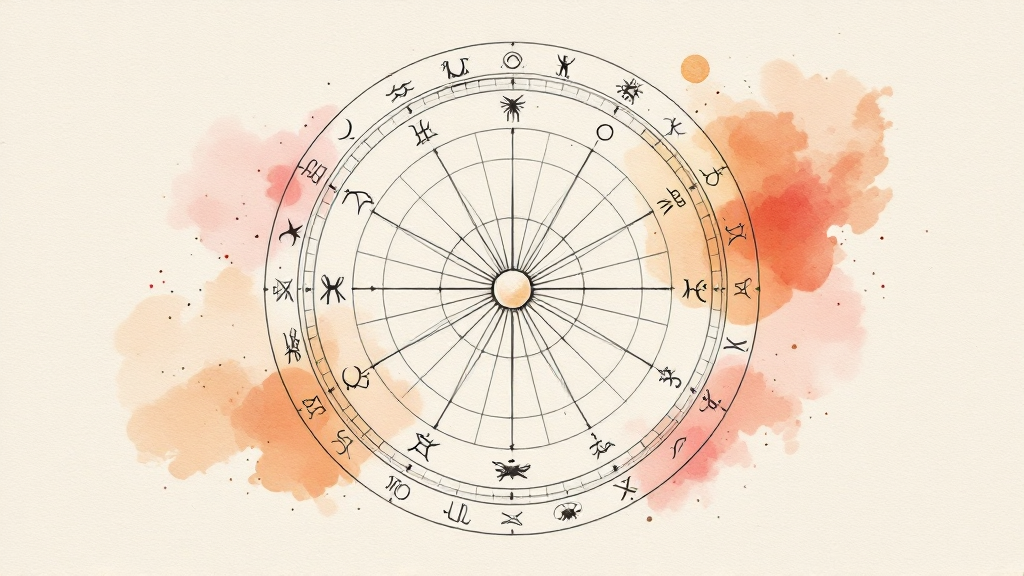
A natal chart is a precise diagram of the positions of the Sun, Moon and planets at the time of your birth, calculated for a specific place and time. It does not predict events and does not negate free will. It is the language in which astrology describes innate temperament, strengths and growth areas. If this is your first time hearing the term “natal chart,” this article will take you from basic concepts to practical interpretation.
A horoscope from an application that gives a forecast “for Aries” is a simplification to one of 12 parameters. The natal chart takes into account 10 planets, 12 houses and dozens of aspects between them, so it gives a picture hundreds of times more detailed. Let’s look at what these terms mean.
What is a natal chart
A natal chart (from the Latin natalis — “relating to birth”) is a circular diagram on which the astrologer records where significant points in the sky were at the moment of your birth. A standard reading uses:
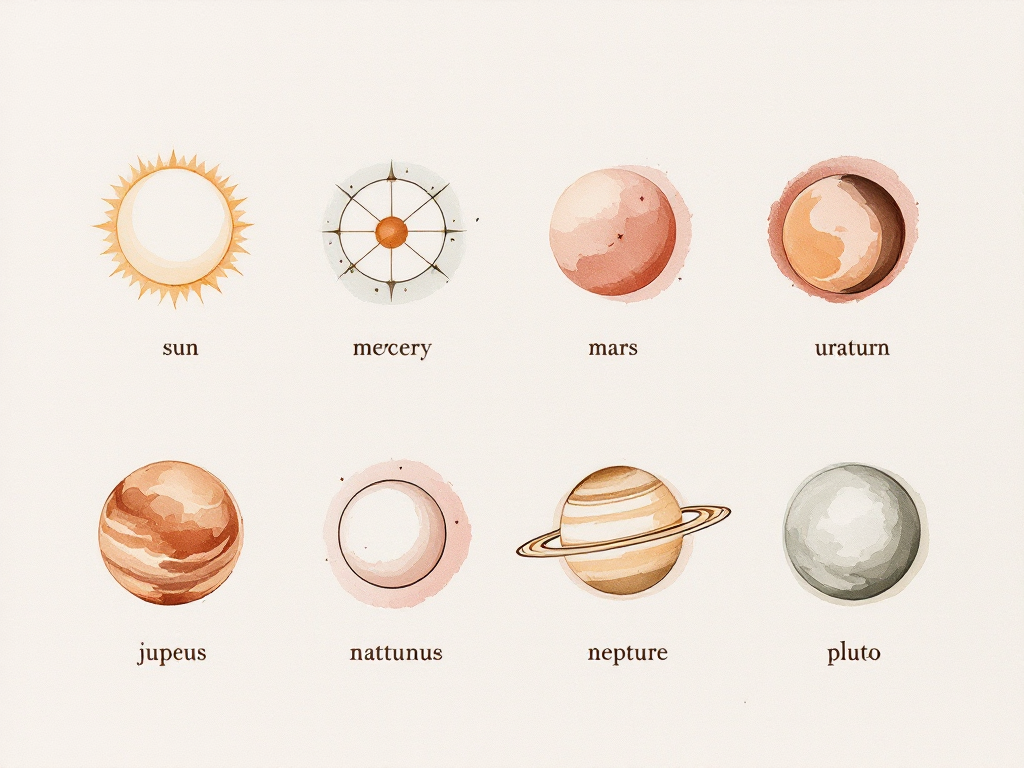
- 10 planets: Sun, Moon, Mercury, Venus, Mars, Jupiter, Saturn, Uranus, Neptune, Pluto. Technically, the Sun and Moon are luminaries, and Pluto has been a dwarf planet since 2006, but in astrology the terminology developed before astronomical reclassifications.
- 12 zodiac signs — sectors of the ecliptic of 30 degrees each, from Aries to Pisces.
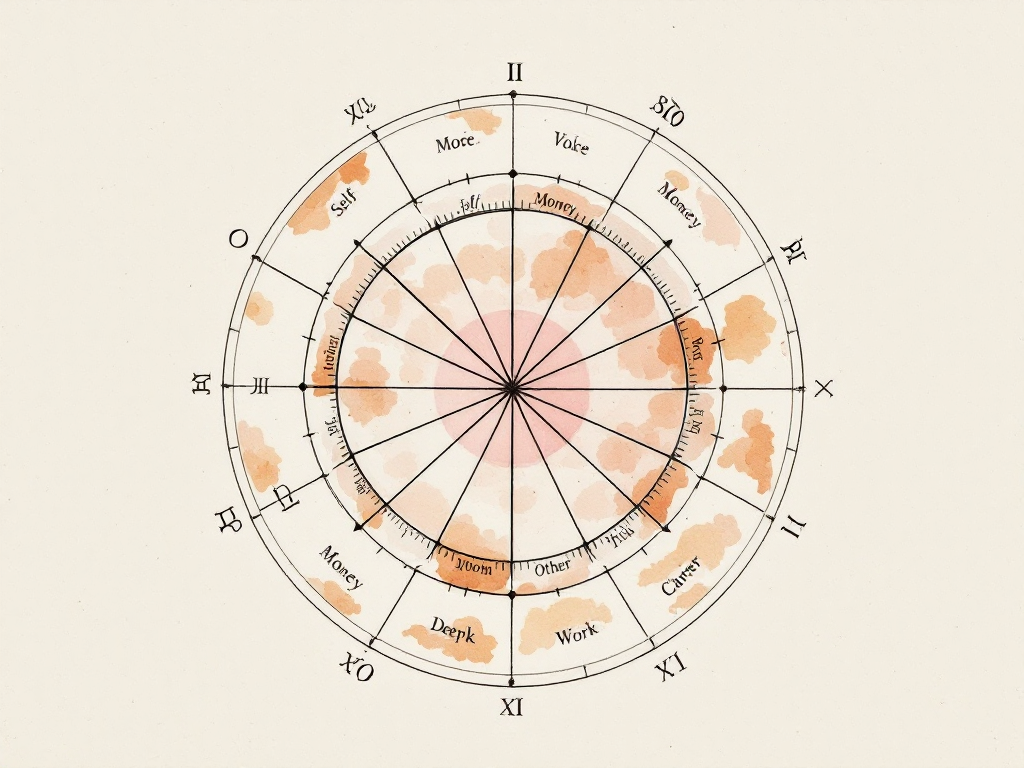
- 12 houses — sectors into which the sky is divided relative to the horizon in your place of birth. Each house describes an area of life.
- Aspects are the angular distances between planets, which show how the energies of the planets interact.
- Angular points: ASC (ascendant, ascending degree), MC (midheaven), DSC and IC.
This means: 10 planets × (sign + house + major aspects to other planets) yield dozens of meaningful factors even before minor details. An astrologer brings these factors together into one coherent reading.
How does a natal chart differ from a “horoscope by sign”
When they say “I am Scorpio,” they usually mean the sign in which the Sun was on the day of birth. This is just one of 10 planets. The Moon can be in Taurus, Mercury in Libra, Mars in Cancer. All these positions describe different facets of character: the Sun is the core of personality, the Moon is emotional needs, Mercury is a style of thinking, Venus is relationships and taste, Mars is a way of acting. The natal chart shows all these layers at the same time, so two people with the Sun in the same sign can be completely different.
History of natal astrology
Natal astrology is one of the oldest interpretive traditions. The earliest known individual horoscopes are found in Babylon and date back to around the 5th century BCE. Greco-Egyptian astrology of the Hellenistic period (3rd century BCE–3rd century CE) formed the system of houses, aspects and rulers that is still used today.
A key source of the classical Western tradition is the Tetrabiblos by Claudius Ptolemy (2nd century CE) — four books in which the Alexandrian mathematician systematized the astrological knowledge available to him. Through Arab scholars of the Middle Ages (Al-Biruni, Mashallah), Ptolemy's texts returned to Europe and formed the basis of Renaissance astrology.
In the 20th century, the natal chart experienced a rebirth. Alan Leo (1860–1917) was a British astrologer who shifted his focus from predicting events to analyzing character. His books popularized the idea that “a chart is a portrait of the soul.” A little later, Dane Rudhyar (1895–1985) combined astrology with the humanistic psychology of Carl Jung and Abraham Maslow. His “humanistic astrology” viewed the chart not as a verdict, but as a map of potentials that a person may or may not realize.
We are born at a certain moment, in a certain place, and like the wines of that year, we have the qualities of the year and season in which we were born.
The quotation captures the modern view of the natal chart: not “the stars decide for you,” but “you were born at a specific moment in time, and this moment has a recognizable quality.”
How it works: mathematics and symbolism
Technically, a natal chart is a calculation of the positions of celestial bodies from ephemerides (tables of celestial positions) for a given date, time and geographic location. Accuracy depends on two things: the quality of the ephemeris and the house system.
Ephemerides
Modern calculations are based on the Swiss Ephemeris — high-precision data based on NASA JPL ephemerides. The error for planets is fractions of an arcsecond per thousand years. This means that the positions of the Sun, Moon and planets in your chart are calculated with astronomical accuracy.
House systems
Dividing the sky into 12 houses is a mathematical procedure, and there are several different variations:
- Placidus is the most common system in Western astrology of the 20th–21st centuries, based on the division of the diurnal arc of the Sun. Works correctly between 66° south and 66° north.
- Koch is a modification of Placidus, popular in the German school.
- Equal House — each house spans 30° from the ascendant. It can be useful at high latitudes, where some quadrant house systems become difficult to calculate or interpret.
- Whole Sign — the oldest system, where each house coincides with a zodiac sign; it returned to practice in the 1990s with renewed interest in Hellenistic astrology.
If you were born in high latitudes (Murmansk, Norilsk, St. Petersburg in the winter months), Placidus may give highly distorted houses. In such cases, astrologers switch to the Whole Sign or Equal House system. On astronavi you can select the house system in the calculation settings.
Aspects
An aspect is the angle between two planets on the ecliptic. There are five main aspects:
- Conjunction (0°) — fusion of energies, very strong interaction.
- Opposition (180°) — tension, the “either-or” axis, requires balance.
- Trine (120°) — harmony, natural flow, sometimes laziness.
- Square (90°) — conflict, a point of growth through overcoming.
- Sextile (60°) — an opportunity that is revealed through action.
The aspect “works” not at an exact degree, but within an orb — an allowed deviation from the exact angle. For conjunctions and oppositions the orb is usually 8–10°, for trine and square 6–8°, for sextile 4–6°. The more precise the aspect, the stronger it is reflected in a person’s character.
12 houses and their themes
The houses are read from ASC counterclockwise and describe areas of life:
- First house — personality, appearance, the impression you make, way of presenting yourself to the world. The cusp of the first house is the ascendant, the most personal point of the chart.
- Second — money, material resources, values and what you consider “yours”. It shows not only your income, but also what gives you a sense of security.
- Third — immediate environment: brothers and sisters, neighbors, short trips. Thinking style, speech, correspondence, initial education.
- Fourth — psychological foundation, family roots, childhood and parental home. The lowest point of the chart (IC) is the most hidden self. This same house describes the end of life and everything that forms the feeling of “home” within.
- Fifth — creative self-expression, romantic interests, children, play, pleasure. Activities pursued for enjoyment rather than practical benefit.
- Sixth — daily work, work rhythm, health and the body as a tool. Your attitude to routine and service: whom you help, and how, out of a sense of duty.
- Seventh — serious partnerships: marriage, long-term alliances, open opponents. The cusp is the descendant, the “mirror” of the ascendant: who you attract and with whom you enter into a contract.
- Eighth — crisis transitions and psychological transformation. Other people's resources, inheritance, debts, joint finances. Sexuality as intimacy and vulnerability. Anything that requires a part of yourself to die in order to be reborn.
- Ninth — worldview, great meanings, philosophy and religion. Higher education, teaching, long-distance travel as an experience of expansion. Everything that takes you beyond the usual picture of the world.
- Tenth — public role, career vector, reputation and social status. Cusp — MC, the highest point of the chart: how society sees you and what you strive for.
- Eleventh — friendship, communities and collective projects. Long-term goals, hopes, role in the group. Connections based on shared ideas rather than personal intimacy.
- Twelfth is the most multi-layered house of the chart:
— subconscious, secret losses, hidden enemies, isolation and what we hide from ourselves; — hospitals, monasteries, rehabilitation, prisons — everything that takes you beyond ordinary social life through care or isolation; — inspired creativity, mystical experience, charity, compassion, inner work. Strong planets in the 12th may be found in the charts of poets and of people who need psychological support alike — this house is where the outer world gives way to inner depths.
What the natal chart shows you personally
A complete reading is built in layers, from general to specific:
Elements and modalities
First, look at which elements (Fire, Earth, Air, Water) and modalities (cardinal, fixed, mutable) contain the most planets. This gives a quick portrait of the temperament: much Fire suggests energy and initiative; much Water, sensitivity and intuition; much Earth, practicality; and much Air, communication.
Luminaries and Ascendant
Next are three key points: the Sun (your sense of self), the Moon (emotional nature) and the Ascendant (how you present yourself to the world). They are sometimes called the “Big Three.” Together, they already account for about 70% of what makes a character reading recognizable.
ASC vs MC
ASC (ascendant) is the point rising on the eastern horizon at the time of birth. This is the “mask,” the first impression you make and the body. MC (Medium Coeli, midheaven) — the highest point of the ecliptic, responsible for the public role, career vector, reputation. ASC describes how those close to you see you; MC describes how society sees you.
House rulers
Each sign has a ruler (planet). If the ascendant is in Taurus, the ruler of the first house is Venus, and its position in the chart will show exactly how your first house is manifested. Analyzing the house rulers adds another level of depth.
Aspects as plots
The final layer is aspects. A Moon–Saturn square may describe emotional restraint and a sense of duty inherited from the family. A Venus–Jupiter trine may suggest natural generosity and ease in relationships. Each aspect is a small story within your personality.
Who can benefit from this?
- On the threshold of a choice — study, profession, move. The chart can highlight which path resonates with the innate disposition.
- In a crisis of self-understanding — when “everything is fine, but it’s as if I’m not living my own life.” The chart can help you notice what needs are being ignored.
- In relationships — synastry (comparing two charts) shows areas of attraction and friction.
- For parents — a child’s chart does not “determine fate”, but helps to understand their temperament from an early age.
Common myths and mistakes
Myth 1. “The natal chart is destiny, nothing can be changed.” The chart describes potential and predispositions, but does not prescribe actions. Two people with the same Mars-Saturn square can realize it as chronic anger at themselves — or as a disciplined ability to work for a long time.
Myth 2. “If I don’t know the exact time of birth, the chart is useless.” Without the exact time, only the house and the ascendant are lost. The signs and aspects of the planets (except for the Moon) remain correct. If you know “morning”, “afternoon” or “evening”, the astrologer will build a chart with tolerance, and most of the meanings will be preserved.
Myth 3. “Retrograde Mercury in the natal is bad.” About 20% of people are born with Mercury retrograde. This is not a defect, but a feature of thinking: internal speech is stronger than external speech, interest in hidden meanings, a tendency to edit.
Myth 4. “It is enough to read the natal chart once.” There is only one chart, but your relationship with it changes with age. At 25 you may see one thing in it; at 40, something else. It is worth returning to it at key life transitions.
Natal astrology is a tool for self-reflection and not a replacement for psychotherapy or medicine. If you are experiencing an acute crisis, depression or anxiety disorder, consult a specialist. The chart can offer support in this process, but it is not a treatment.
On astronavi, the natal chart is calculated with the Swiss Ephemeris with arcsecond-level precision. The interpretation is tailored according to your data: the elements, modalities, luminaries, ascendant, house rulers and aspects in their orbs are taken into account. You can choose the house system, presentation format and depth of analysis — from a short portrait to a detailed analysis. If you want to start with the basics, build a free natal chart on the practice page and then move on to the sections that interest you.
Questions and answers
What is a natal chart in simple terms?+
It is a diagram showing the positions of the Sun, Moon and planets at the moment of your birth. It describes innate temperament, strengths and areas for growth in much more detail than a horoscope based on one zodiac sign.
Can I create a natal chart without my exact birth time?+
Yes, but without a birth time the ascendant and houses cannot be determined. The positions of the Sun and planets (apart from the Moon) and the aspects between them remain reliable. If you know even an approximate time, much of the chart can still be interpreted.
How does a natal chart differ from a horoscope based on zodiac sign?+
A zodiac-sign horoscope considers only the Sun, one of ten significant points. A natal chart considers 10 planets, 12 houses and dozens of aspects, producing a picture hundreds of times more detailed.
Which house system should I choose: Placidus, Koch or Whole Sign?+
Placidus is a standard choice in Western astrology and suits most people. Above 60° latitude it can produce distortions; Whole Sign or Equal House is often preferable there. You can choose the system in astronavi’s calculation settings.
Does a natal chart change over time?+
The chart itself does not change: it is fixed at the moment of birth. Its interpretation can deepen with age, while transits, progressions and solar returns show how its themes unfold in particular years.
Is a natal chart destiny?+
No. It is a map of potential. It describes dispositions but does not dictate actions. People with similar charts can live very different lives depending on their choices, environment and awareness.
Can I create a natal chart for free?+
Yes, natal chart calculations are available for free on astronavi. Extended personal interpretation of aspects and houses is available in paid packages.
Ready to try Natal chart for yourself?
Open this area in your dashboard for a reading based on your details.