Lunar calendar today: phase, lunar day and suggested activities
The lunar calendar is an ancient way to mark time that remains in use today. Explore Moon phases, lunar days and zodiac signs, and learn how to use the calendar without mysticism.
The lunar calendar is probably humanity’s oldest calendar system, older than solar calendars. Sumerians, Babylonians, Chinese, Jewish, Muslim and Slavic communities all developed early calendars around the Moon because its cycle is visible to the naked eye and easy to count. Today, the lunar calendar has found new uses — no longer as the main way to measure time, but as a guide to gardening, hair care and personal rhythms.
In this article, we will look at what a lunar day is, how the four lunar phases differ, what “Moon in a sign” means, and how to practically use the lunar calendar — without promises of magic, but also without dismissing a tradition used by millions for decades.
What is a lunar calendar
The lunar calendar is a timekeeping system in which the basic unit is the synodic lunar month: the period from one new moon to the next, about 29.5 days. Within this month there are:
- Lunar days — segments between two consecutive moonrises.
- Phases of the Moon — four stages of illumination of the disk: new moon, first quarter, full moon, last quarter.
- Moon in a zodiac sign — the Moon changes sign approximately every 2.5 days, moving through the entire zodiac in a month.
Unlike a regular calendar, where a day lasts exactly 24 hours, lunar days last on average 24 hours 50 minutes. This means that the lunar day begins each time a little later than the calendar one — and sometimes it seems to “fall out”: there are calendar days that include the end of one lunar day and the beginning of the next, without a day in the middle. And vice versa — there are days with three lunar days.
Because of this difference, about 29.5 lunar days fit into a synodic month, and in a year there are about 354 lunar days versus 365 solar days. Therefore, the lunar year is 11 days shorter than the solar year — and any “lunar” holidays (for example, Muslim Ramadan) are shifted every year.
Brief history
The earliest known lunar calendars are Sumerian (3rd millennium BCE) and Babylonian. They were the basis for later calendar systems in Mesopotamia and became the ancestors of the names of months and weeks familiar to us.
In ancient China, the lunisolar calendar took shape by the Shang era (~1600 BCE) and is still used to determine holidays and agricultural cycles. The Jewish calendar is lunisolar, the Muslim calendar is purely lunar.
In the European tradition, the lunar calendar existed for a long time parallel to the solar one: monks calculated Easter dates using the Moon, peasants sowed crops and sheared sheep “according to the Moon,” sailors checked navigation with the lunar tides. Only with the spread of accurate mechanical watches and the Gregorian calendar (1582) did lunar counting fade into the background — but did not disappear.
In the 20th century, biodynamic farmers (Maria Thun, Rudolf Steiner) and cosmetologists renewed interest in the lunar calendar. Their observations are presented as empirical work based on large samples rather than astrological theory. Practices such as choosing a “lunar day for a haircut” or “planting on a waning Moon” grew from this tradition.
Nature never breaks its laws. It only reminds those who are used to ignoring them about them.
Four phases of the Moon
This is the main pattern of the lunar month. Each phase lasts approximately 7.4 days and has its own character.
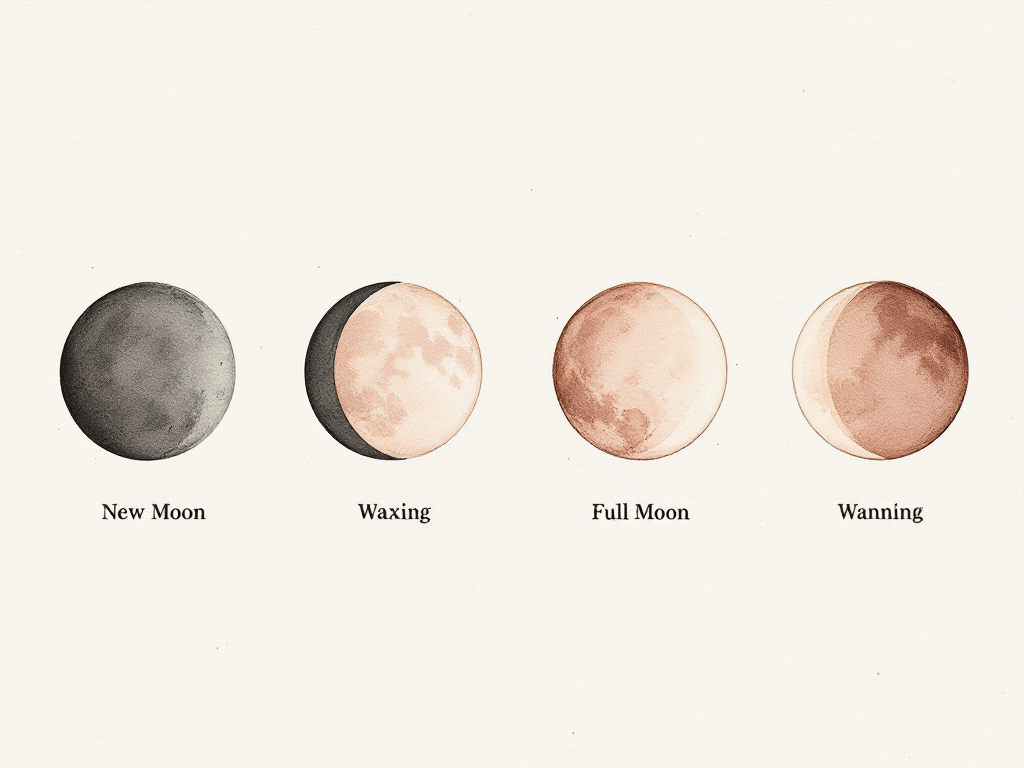
New moon and waxing Moon (1st–7th lunar day)
The Moon is between the Earth and the Sun, the disk is not visible or a thin crescent is visible. A phase associated with beginnings: time for new intentions, starting projects, sowing seeds, literally and figuratively. During the first 1-2 days after the new moon, many people notice lower energy — this is normal, the cycle has just begun.
Good things to do: write down intentions, start something new, sow seeds if you garden. Haircuts are traditionally not recommended during this phase — hair is believed to grow more slowly (this is an empirical observation of hairdressers, not a strict rule).
First quarter and waxing Moon towards full moon (8–14 lunar day)
The moon is half illuminated and growing. Period of active action: what was planned at the new moon begins to take shape. Most people's energy levels are high and productivity increases.
What is good to do: active work, negotiations, physical activity, promoting projects. A good time for presentations and public speaking.
Full moon and waning Moon from the full moon (15–22 lunar day)
The moon is fully illuminated. This is the peak of the cycle — the moment of culmination, maximum visibility. Emotions are often on the surface, and many people report changes in sleep quality (this is confirmed by research, in particular the meta-analysis of Cajochen et al., 2013).
What’s good to do: finish what you started, audit projects, see the results. Astrologers do not consider this the best time for important new starts and complex conflict negotiations — the emotional background is too intense.
The full moon does not “drive you crazy” — this is a popular exaggeration. But there is a real effect on sleep: some people have a harder time falling asleep in the days before and after the full moon. If you are sensitive to the Moon, take this into account when planning.
Last quarter and waning Moon towards the new moon (lunar day 23–29)
The moon is half illuminated and waning. A period associated with release and clearing out. Energy decreases, but this is not a “decline”, but a natural decline before the next cycle.
What is good to do: cleaning, sorting out rubble, completing debts, thorough cleaning — literally and in business. Haircuts on the waning moon are traditionally considered favorable for those who want slower hair growth (for example, unwanted hair). A good phase for detoxes and fasting — but this is a matter of your health, not a lunar obligation.
Moon in zodiac sign
In addition to the phase, the sign in which the Moon is currently located is important. It moves through a sign in 2–2.5 days, and each sign colors life in its own way.
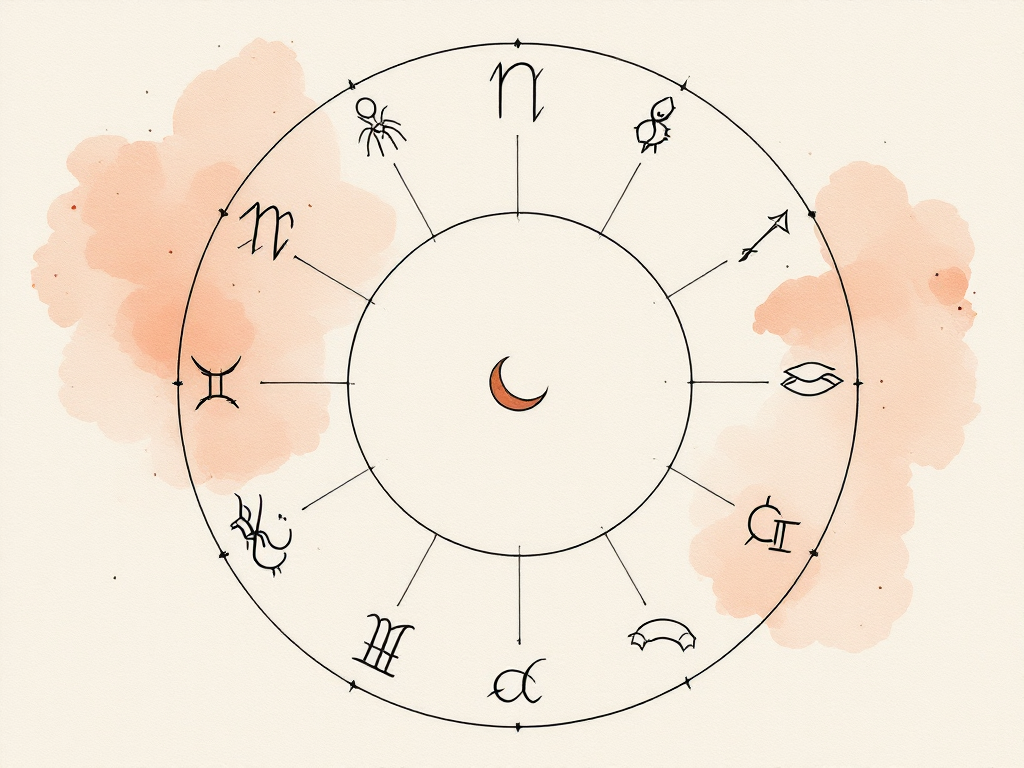
One well-known practical system is Maria Thun’s biodynamic farming calendar. She divided the signs into four elements and associated each with a type of plant:
- Fire (Aries, Leo, Sagittarius) — fruit days: tomatoes, peppers, apples.
- Earth (Taurus, Virgo, Capricorn) — root days: carrots, potatoes, beets.
- Air (Gemini, Libra, Aquarius) — flower days: roses, cauliflower, flower bulbs.
- Water (Cancer, Scorpio, Pisces) — leaf days: lettuce, spinach, cabbage.
This is presented as observation rather than magic: in large samples, plants sown on a “suitable” day in this system are said to show slightly better yields. The effect is described as small but statistically reproducible, which is why biodynamic farmers have followed the Thun calendar for over 80 years.
In everyday life, the same elements can be used as a guide to the mood of the day:
- With the Moon in fire signs, the day favors energy, action and physical activity.
- With the Moon in earth signs, the day favors practical, repetitive tasks and household chores.
- With the Moon in air signs, the day favors conversation, negotiation and learning.
- With the Moon in water signs, the day feels more emotional and suited to creativity and reflection than strict logic.
How to use the lunar calendar practically
There is no need to turn the lunar calendar into a new system of prohibitions. Sound practice looks like this.
1. Know the current phase. This is a basic guideline. The waxing Moon is the phase of start and growth. Waning is the phase of completion and letting go. This knowledge is already sufficient for most decisions.
2. Consider the new moon and full moon. These two events are the anchor points of the month. On the new moon, it is useful to write down your intentions and not start critical tasks on the first day. During the full moon, do not plan difficult emotional conversations if you are highly sensitive to lunar cycles.
3. Haircuts and beauty care are optional. Hairdressing tradition: cut your hair on the waxing Moon if you want rapid growth; on a waning Moon — if you want it slow. This is empiricism, not law.
4. Gardening, if you enjoy it. The Thun calendar is presented as useful: if you grow vegetables or flowers, it may offer a small but noticeable improvement.
5. Do not let it become an obsession. The lunar calendar is a supportive rhythm, not a rigid schedule. If you have to hold an important meeting on a full moon in a water sign, you will hold it and do it well. The calendar is a background, not a verdict.
Common myths
“You can’t start anything on a full moon.” You can. This is simply a phase in which energy goes into the manifested, and not into the new. A big full moon project is normal. Not the best day just for subtle emotional starts.
“The lunar day determines whether the day will be successful.” No. The lunar day sets the quality of the background, but the luck of the day consists of dozens of factors — your condition, the weather, the environment, the context of the week. Lunar day is one of them, not the main one.
“If the Moon is in a “bad” sign, nothing will work out.” There are no “bad” signs for the Moon. There are signs in which the Moon feels comfortable (Cancer, Taurus) and others where it is considered less comfortable (Scorpio, Capricorn). But this is about the emotional background, and not about the result of things.
“The lunar calendar is esoteric.” It is a calendar system. In that sense it is no more esoteric than the Gregorian calendar. Biodynamic agriculture, hairdressing traditions and medical chronobiology are presented here as empirical practices rather than magic.
Who benefits from the lunar calendar
— For those who are engaged in gardening or vegetable gardening. — For those who are sensitive to the phases of the moon and want to consciously integrate into their natural rhythm. — For hairdressers, cosmetologists and their clients — tradition really works in large samples. — For those who keep a diary and plan the months, lunar cycles provide beautiful markings. — For those just curious, this is an ancient practice that unites you with thousands of years of human culture.
In astronavi, the lunar calendar shows the current lunar day, phase, moon sign and suitable practices — calculated using the Swiss Ephemeris with minute accuracy. This is a calm tool for those who want to live in harmony with their natural rhythm, without esoteric noise and obsessive prohibitions.
Questions and answers
How long is a lunar day?+
The interval between successive moonrises averages about 24 hours 50 minutes. Because it is longer than a calendar day, a lunar day may span two dates and some dates may contain parts of several lunar days.
How do I find today’s lunar day?+
The count begins at the new moon. The first lunar day lasts from the new moon until the next moonrise, and each subsequent day begins at a moonrise. The astronavi lunar calendar calculates this using the Swiss Ephemeris and your time zone.
How many phases does the Moon have?+
Four main phases: new moon, first quarter, full moon and last quarter. Each lasts about 7.4 days. Intermediate stages can also be distinguished: waxing crescent, waxing Moon, waning Moon and old crescent.
Can I get a haircut at the new moon?+
Traditional hairdressing advice discourages it on the belief that hair grows more slowly afterward. This is an observation-based tradition, not a firm rule. It suggests cutting on the waxing Moon for faster growth and on the waning Moon when slower growth is preferred.
What does “Moon in a sign” mean?+
The Moon moves through the zodiac in about 27 days, spending roughly 2–2.5 days in each sign. In this tradition, fire signs favor activity, earth signs practical tasks, air signs communication and water signs emotional or creative work. Biodynamic farming also links these groups to fruits, roots, flowers and leaves.
Does a full moon really affect sleep?+
Yes. The article cites Cajochen et al. (2013) as reporting a small but statistically significant difference in sleep around the full moon: people may take longer to fall asleep and spend less time in deep sleep. The effect is modest and varies by person.
Does the lunar calendar work, or is it a placebo?+
Some effects are presented as empirically observed: lunar tides (physics), effects on sleep (medicine) and biodynamic farming yields (crop statistics). Haircut timing and household recommendations rely more on tradition than strict evidence. The lunar calendar is a supportive tool, not magic; it is most useful when applied calmly and reasonably.
Ready to try Lunar calendar for yourself?
Open this area in your dashboard for a reading based on your details.