Dream interpretation: how to understand symbols and emotions
Explore three approaches to dream interpretation—Freud, Jung and modern neuropsychology. Learn how a formulaic dream dictionary differs from personal reflection, and how to work with your dreams without self-deception.

People have long been fascinated by dreams. They were interpreted in Ancient Egypt and Babylon thousands of years before Freud. We still discuss them with family after waking. And, more importantly, we continue to treat them as something significant, even if in the rest of our lives we consider ourselves to be completely rational people.
This article is about interpreting dreams honestly, without formulaic dream dictionaries that say “a tooth falling out means bad news,” but also without dismissing the practice altogether. We will analyze three key schools - Freud, Jung and modern neuropsychology - and show how to work with your dreams as a tool for self-understanding.
What is a dream and why interpret it
Dreaming involves brain activity during rapid eye movement (REM) sleep, when emotion-processing and visual-memory areas are active, while awareness of the outside world recedes. In this phase, the brain weaves the impressions of the day, old memories, anxieties and hopes into a plot that does not obey the logic of wakefulness.
To interpret a dream is to approach it as a personal message from yourself. Not a “message from space,” but a way for the psyche to process what you didn’t have time or didn’t want to think about during the day.
Important idea: dreams do not predict the future. If you dreamed of a fire, and a week later there was a fire, this is a coincidence and the work of selective memory (we have forgotten thousands of other dreams because they “did not come true”). Dreams can, however, reflect what is already happening within you.
How does an “honest analysis” differ from a dream book
The classic dream book is a dictionary: symbol → ready-made meaning. “Ring - for a wedding”, “water - for tears.” It sounds convenient, but it doesn't work for two reasons:
- The same symbol means different things to different people. For one, water means tears and fear, for another, the sea from a happy childhood, and for a third person, an everyday memory (my daughter spilled water yesterday).
- Context is more important than symbol. Not “I dreamed of a snake,” but “it crawled after me along a narrow corridor, I couldn’t breathe.” The emotion is more important than the subject.
Therefore, instead of dream books, a mature interpretation works with the plot, associations and state of the dreamer.
History: three schools of interpretation

Sigmund Freud: dreams as disguised wishes
In 1899, Sigmund Freud published The Interpretation of Dreams, a book that revolutionized the way dreams were viewed in European culture. The main thesis: dreams provide a “royal road to the unconscious” and can disguise the fulfillment of a repressed wish.
Freud introduced two important concepts:
- Manifest content of the dream is what you remember after waking up: plot, images, actions.
- Latent content - what is hidden underneath: suppressed impulses, fears, conflicts.
Between them, “dream work” operates: condensation (when one image combines several ideas), displacement (an important emotion is transferred to a harmless detail), symbolization. The interpreter's task is to follow this path back through the dreamer's free associations.
The interpretation of dreams is the royal road to knowledge of the unconscious in mental life.
Freud’s strength was proposing a systematic method for exploring dreams. A weakness was his insistence on the sexual nature of the repressed material is exaggerated from a modern point of view. But the basic idea - that a dream says something about your mental world - became the foundation for all subsequent schools.
Carl Gustav Jung: a dream as an encounter with archetypes
Carl Jung, Freud's student, disagreed with Freud about the nature of the unconscious. Jung believed that in addition to the personal unconscious (biography, repression), there is a collective unconscious - a shared layer of the psyche that we inherited from humanity. The collective unconscious contains archetypes: stable images and plots that are repeated in myths, fairy tales, religions and dreams of different cultures.
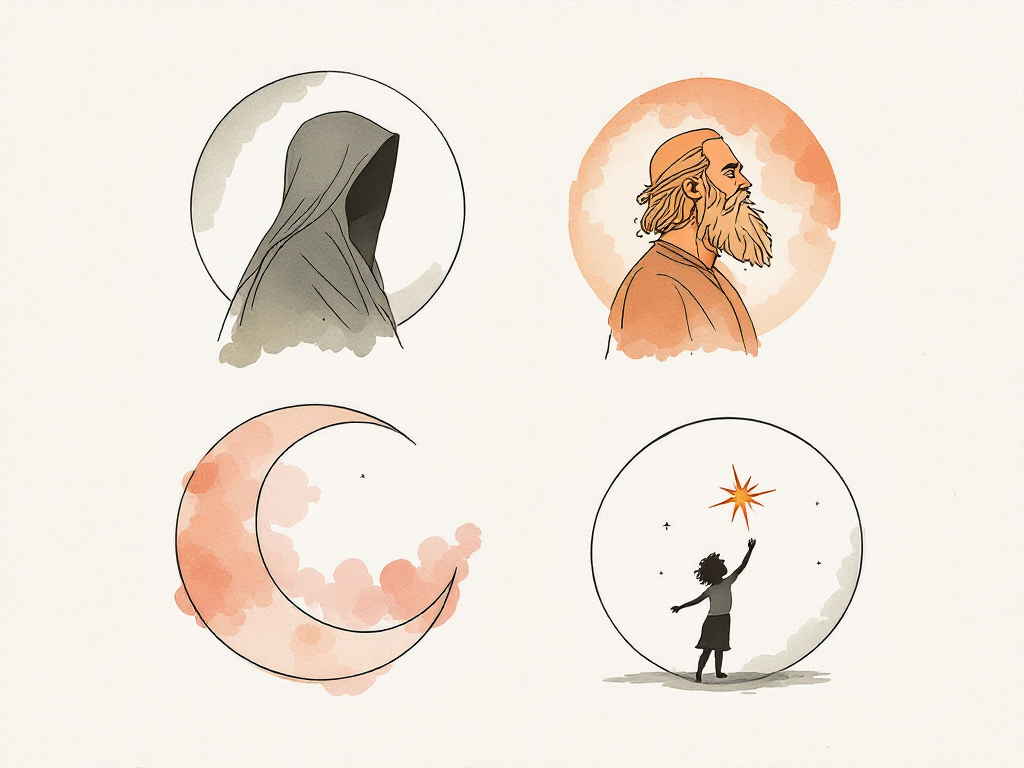
Key Jungian archetypes you may encounter in your dreams:
- Shadow is a repressed, “unaccepted” part of you. In a dream, it usually appears as a pursuer, a dark figure, an enemy of the same sex.
- Anima/Animus - the internal image of the feminine in a man and the masculine in a woman. They appear as a mysterious partner, a guide, an important figure of the opposite sex.
- Self is the archetype of integrity. It can appear as a child, a wise old man, a luminous circle, a mandala.
- Persona is a social mask, the image you present to others. Dreams about lost documents or public nudity may express concerns about the Persona.
Jungian analysis of a dream is not limited to “decoding”. This is a dialogue: You ask the dream what it wants to tell you, and gradually learn to distinguish archetypal plots under the “ordinary” scenery.
Modern neuropsychology: dreams and processing experience
The third perspective comes from science. Since 1953, when REM sleep was discovered, psychophysiology has learned a lot about what happens in the brain at night.
This perspective describes several processes associated with sleep:
- During sleep, memory consolidation works - the transition of information from short-term memory to long-term memory.
- Emotional regulation is active - the brain “digests” daytime stress and reduces its intensity.
- Creative processing occurs - there are known cases when solutions to scientific and creative problems came in a dream (from Mendeleev to Kekulé).
From this point of view, a dream is not a “message”, but a process. But it is a process in which you can notice what your mind is working through: what themes are repeated, what emotions dominate, what figures from the past are returning.
How it works: five steps to analyze a dream
The modern “empathic” dream analysis we use at astronavi combines the best of the three schools. Here is a working algorithm that you can apply yourself.
Step 1. Record the dream immediately
Place a notepad or phone by your bed. When you wake up, before checking your messages, write down everything you remember: plot, figures, colors, emotions, bodily sensations. In 10 minutes half of it will be gone, in an hour almost all of it will be gone.
Step 2. Name the main emotion
Not “what was the dream about,” but how you felt. Anxiety? Relief? Shame? Delight? Emotion is the main key to meaning. Often the plot is completely strange, but the feeling is very familiar from real life.
Step 3. Collect associations to key images
Take 2-3 of your most vivid dream images and ask yourself: what comes to mind when I think about this? Not “what does this mean in the dream book”, but what does this mean for me personally. A house from childhood, where we haven’t been for 20 years. A former colleague with whom we have not spoken for 5 years. Closed door.
Step 4. Relate to current life
What in your life right now evokes a similar feeling or a similar plot? Often the connection becomes obvious: a dream about an exam for which you are not ready - about a real conversation for which you are not ready. A dream about a missing child is about a project for which you are afraid.
Step 5. Frame the question, not the answer.
A good dream analysis ends with not “here’s what it means”, but “here’s something to think about”. A dream, like a good conversation with a friend, does not give an answer - it helps you hear yourself.
If you keep a “dream journal” for 2-3 weeks in a row, you will discover recurring themes that you did not notice in individual dreams. These recurring themes may be the most valuable insight from the practice.
What does dream analysis show you?
With regular practice, dream interpretation provides three things that are difficult to obtain otherwise.
Access to your own emotions
During the day we are often busy, distracted, and rationalizing. A dream may bypass that filter and suggest how you feel about a situation, a person, a decision. Sometimes that feeling emerges before you acknowledge it while awake.
Early signals
The psyche often “knows” about a problem before consciousness does. Fatigue, burnout, an unhealthy relationship, a bad decision—all of these may appear in dreams before you recognize them consciously.
Creative resource
Plots, associations, unexpected combinations are excellent material for creative and design work. Many writers, artists and scientists keep “dream journals” as a source of ideas.
Myths about dream interpretation
A few common misconceptions that hinder mature practice.
Myth 1. “If you dreamed it, it will come true.” A dream reflects your inner world, not the future. Coincidences happen because we remember “hits” and forget hundreds of “misses.”
Myth 2. “There is one correct dream dictionary.” There is no single authoritative dictionary. Each reflects its author’s interpretations, not an objective database. You can use a dream dictionary for ideas, but not as a final authority.
Myth 3. “All dreams have a deep meaning.” Most dreams are “cleaning up” the day, and there is nothing significant in them. Deep meaning should be sought in vivid, repetitive and emotionally charged dreams.
Myth 4. “If I don’t remember dreams, I don’t have an unconscious mind.” People dream during REM sleep, which recurs about 4–6 times a night. It’s just that not everyone has the habit of recording them.
If you regularly have nightmares that disturb your sleep, or dreams about traumatic events return for years, these are not “signs”, but possible symptoms. The appropriate help here is a psychotherapist who specializes in trauma, or a sleep specialist, rather than a dream interpreter.
Interpretation of dreams on astronavi
On astronavi, dream interpretation takes the form of structured analysis rather than a 1990s-style dream dictionary. You describe the dream in free form - plot, figures, emotions - and the service analyzes it in three planes: personal (what this could mean about your current life), archetypal (what Jungian themes could be at the core), and contextual (how this plot sounds in your lunar or numerological cycle).
This is not a prediction or a “guaranteed answer” - it is a frame in which you can hear yourself better. To try an analysis of your last vivid dream, go to the dream interpretation section and describe what you dreamed. The best time to record is the first 10 minutes after waking.
Questions and answers
How is dream interpretation on astronavi different from a dream dictionary?+
A dream dictionary offers fixed answers, such as “tooth = illness” or “water = tears.” We consider the plot, your emotions and your life context, then suggest how Freudian, Jungian or modern approaches might illuminate the dream. We make no promise to predict the future.
Should I take Miller’s or Freud’s dream interpretations literally?+
No. Miller’s dream dictionary is a late-19th-century work of personal interpretations. Freud’s *The Interpretation of Dreams* was scholarly for its time, but even Freud cautioned against universal symbol meanings: the dreamer’s own associations matter.
What if I keep having the same nightmare?+
A recurring dream may mean your mind is working through something important. Write down the details and consider your emotions and current circumstances. If nightmares recur for weeks and disrupt sleep, consult a psychologist or sleep specialist rather than a dream dictionary.
Does every dream need interpretation?+
No. Many dreams reflect memory processing and the events of the day without a deeper meaning. Vivid, emotional or recurring dreams, especially those that stay with you after waking, may be worth exploring.
What is an archetype in a Jungian dream?+
An archetype is a recurring image from the collective unconscious, such as the Shadow, Anima/Animus, Wise Old Man, Great Mother or Self. In dreams it may appear as an emotionally charged figure: a faceless pursuer, a luminous guide or an ancient woman.
Why do I not remember my dreams?+
Dreams can fade within 5–10 minutes of waking if you do not record them. Try a dream journal: keep a notebook by the bed and immediately write down the first images you remember. Recall may improve after 1–2 weeks.
Are dreams connected to my birth date?+
There is no direct scientific evidence of such a link. Some esoteric traditions, including Chinese, lunar and numerological ones, suggest that lunar days or personal cycles affect dreams. Astronavi uses that information as an optional interpretive lens, not a diagnosis.
Ready to try Dream interpretation for yourself?
Open this area in your dashboard for a reading based on your details.