Biorhythms: physical, emotional and intellectual cycles
Explore Wilhelm Fliess’s biorhythm theory: the classical 23-, 28- and 33-day cycles, how to read a chart and what “critical days” mean. We explain its scientific status and its possible use as a self-tracking prompt.
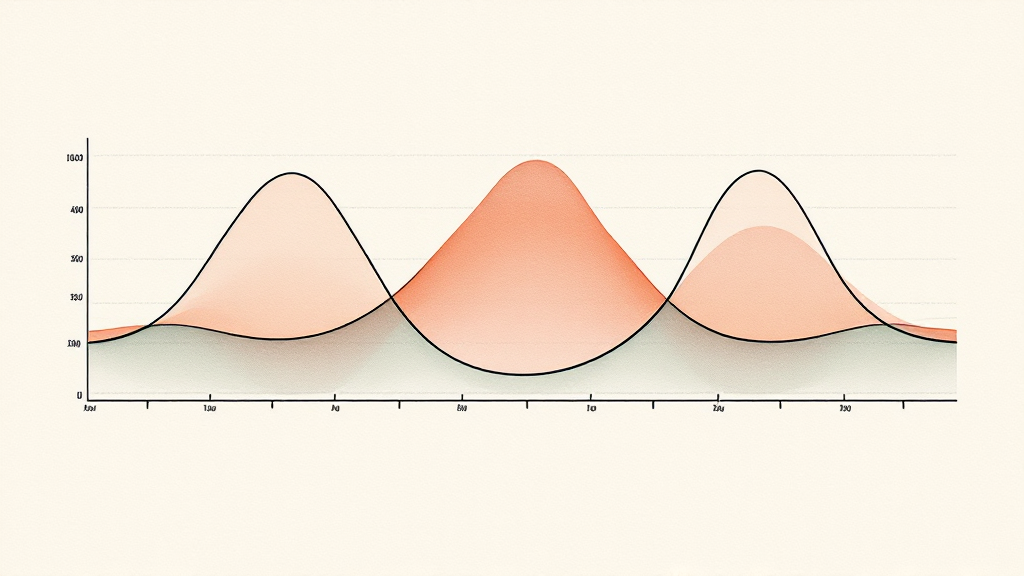
The idea that people have “good” and “bad” days is ancient. Old calendars highlighted favorable and unfavorable periods, athletes have long noticed that their performance rises and falls, and we all know weeks when nothing seems to go right, followed by weeks when everything clicks.
At the beginning of the 20th century, the German physician Wilhelm Fliess tried to formalize this intuition in the form of the theory of biorhythms: three cycles of different lengths, calculated from the date of birth. Since then, the theory has spawned charts, mobile apps and heated arguments about its scientific standing.
This article takes an honest look at classical biorhythms: what they are, how they are calculated, what their charts show, and where useful self-tracking ends and pseudoscience begins. Without false promises or needless skepticism.
What are biorhythms
In its broadest sense, a biorhythm is a periodic change in any biological characteristic. Heart rate is a biorhythm. The sleep–wake cycle is a biorhythm. The menstrual cycle is a biorhythm.
In everyday use, however, “biorhythms” usually refers to the classical theory of three cycles: physical, emotional and intellectual. This is a different, narrower meaning.
Do not confuse classical biorhythms with circadian rhythms. Circadian rhythms are a scientifically established internal cycle of about 24 hours; the discovery of its molecular mechanisms earned the 2017 Nobel Prize in Physiology or Medicine. The classical 23/28/33-day theory is separate and far less reliable.
Three classical cycles
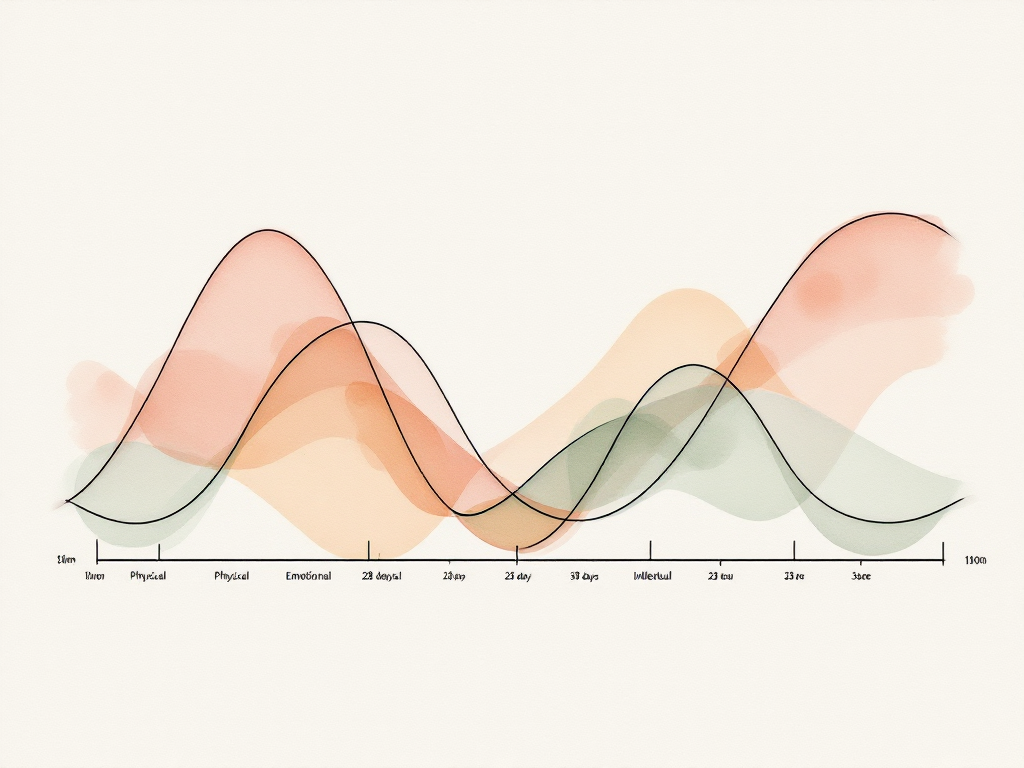
In the classical theory, three cycles begin at the moment of birth, run in parallel and independently:
- Physical cycle - 23 days. Energy, endurance, coordination, recovery speed, immunity.
- Emotional cycle - 28 days. Mood, sensitivity, sociability, creativity.
- Intellectual cycle - 33 days. Ability to concentrate, analytical thinking, speed of decision-making.
Each cycle is represented as a sine wave: the first half of the cycle is an “above zero” (favorable) phase, the second half is “below zero” (low). The day when the graph crosses zero is critical.
History: from Fliess to apps
The history of the classical theory of biorhythms follows a 19th-century idea that resurfaced every 30–40 years.
Late 19th century: Wilhelm Fliess
Wilhelm Fliess (1858–1928) was a German otolaryngologist, friend and correspondent of Sigmund Freud. Based on clinical observations and correspondence with Freud, Fliess proposed that people have two basic rhythms: a “male” 23-day rhythm and a “female” 28-day rhythm, which he associated with “biologically active” periods.
Fliess’s contemporaries reacted differently. Freud was influenced by his ideas for years but later distanced himself; the scientific community remained skeptical. Even so, Fliess’s work became the foundation of the classical theory.
1920s: Alfred Teltscher and the intellectual cycle
The Austrian technical-college teacher Alfred Teltscher added a third cycle - intellectual, 33 days long. He drew on observations of students’ exam performance. This gave the classical theory the three-cycle form it retains today.
1970s: second wave
In the 1970s, biorhythms surged in popularity in the West—especially in the United States and Japan. Calculators, wristwatches and tables appeared that allowed anyone to calculate their charts. Airlines, sports teams and corporations experimented with using biorhythms in planning.
At the same time, the decade also brought the theory’s main rebuttal: dozens of studies have shown that the predictive power of classical biorhythms is no better than chance. Since then, in academic science, Fliess’s biorhythm theory has been considered pseudoscience.
A review of more than 100 studies found that the purported correlations between classical biorhythms and actual physiological, psychological and behavioral measures are not statistically different from noise.
2010s and beyond: a resurgence in self-tracking
The third wave is the current one. With the rise of wearables, fitness trackers, and a culture of “know yourself,” biorhythms have returned—but in a different role. Not as a medical forecast, but as one of the frameworks for self-observation along with the lunar calendar, sleep cycle and menstrual cycle.
How it works: calculating biorhythms
Algorithm
- Take your date of birth.
- Count how many days have passed from your date of birth to today.
- Divide this number by the length of your cycle (23, 28 or 33 days).
- The remainder of the division will show at what point in the cycle you are now.
- Construct a sinusoid one cycle long and find your point on it.
Example
Suppose 11,000 days have passed since your birth.
- Physical cycle (23 days): 11,000 mod 23 = 22. You are at the very last point of the cycle, just before the cycle resets - this is the critical day. Tomorrow a new cycle begins.
- Emotional cycle (28 days): 11,000 mod 28 = 12. You are in the first half of the cycle, closer to the peak. Positive phase.
- Intellectual cycle (33 days): 11,000 mod 33 = 23. You are in the second half, in the “below zero” phase. According to the theory, this is a poor time for complex decisions with lasting consequences.
If you want to count by hand, the formulas are simple. If not, a biorhythm calculator will do it in a second.
Critical days
A critical day is the day the cycle crosses zero. According to Fliess's theory, at these moments the corresponding human system is least stable:
- A critical day in the physical cycle - increased risk of injuries, colds, general “weakness”.
- A critical day in the emotional cycle - increased irritability, emotional swings.
- A critical day in the intellectual cycle - absent-mindedness, errors in calculations and decisions.
The most consequential days, according to the theory, are when two or, especially, three cycles hit zero at the same time.
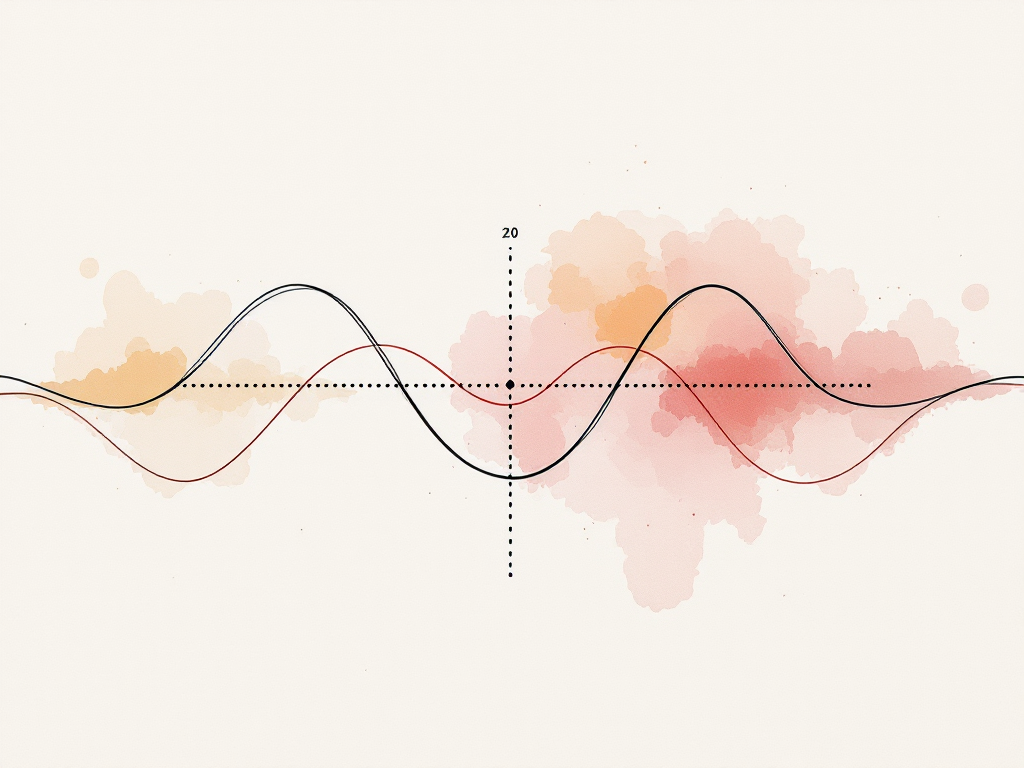
A critical day in the theory of biorhythms is not a reason to sit at home and do nothing. No clinically significant risks have been documented for these days. This is a self-monitoring framework, not a medical warning.
What can a biorhythm chart show you?
If you approach classical biorhythms soberly - as a framework for self-observation, not a forecast - the practice can still be useful in several ways.
Building a habit of checking in with yourself
The main value of biorhythms is less in their “accuracy” than in prompting you to regularly ask yourself “how am I now?”. A morning glance at the chart is a micro-check-in: how energetic am I, what is my mood, and how easily can I think. This habit itself is useful, regardless of any supposed cycle length.
A language for self-understanding
“Today I am at the lowest point of the emotional cycle” is a phrase that can help you name a feeling and discuss it with loved ones. Without a chart, we often live in the feeling of “everything is bad for no reason,” and with a chart we get a reason to say: “I’m now in a low phase, give me three days and I’ll be ready to seriously discuss.”
Adjusting flexible plans
If a deadline can move by a day, or a difficult conversation can wait until you feel more ready, why not adjust the plan? This does not mean “believing in biorhythms as a law of nature,” it means listening to your own state and leaving yourself some room.
What biorhythms do not show
Be honest with yourself:
- Biorhythms do not predict specific events (injuries, illnesses, good luck).
- Biorhythms do not replace medical assessment for real problems with energy or mood.
- Biorhythms do not explain other people's behavior (“he yells at me because he has a critical day” - this is shifting responsibility).
- Biorhythms do not determine the compatibility of partners or employees.
Myths and reality
Here are some common overstatements.
Myth 1. “You can’t fly on planes or drive a car on a critical day.” There is no epidemiological data to support this. Airlines tried taking pilots' biorhythms into account in the 1970s and found no statistically significant results.
Myth 2. “Biorhythmic compatibility predicts success in relationships.” There is no evidence for that. Hundreds of factors influence relationships; “cycle phase” is definitely not the main one.
Myth 3. “If you learn, you can control your biorhythms.” According to theory, cycles are fixed by the date of birth and are unchangeable. You can control your actual sleep, nutrition, and exercise patterns - this affects your well-being much more strongly than any biorhythm chart.
Myth 4. “Biorhythms and circadian rhythms are the same thing.” No. These are different things. Circadian rhythms are a scientific fact; the classical theory of Fliess’s biorhythms is an unproven heuristic.
The best strategy with biorhythms is to treat them as one of the “mirrors” along with your diary, pedometer, sleep tracker and menstrual calendar. Not as the only truth.
Biorhythmic calendar on astronavi
On astronavi, biorhythms are implemented as a daily mini-check-in. You enter your date of birth once; the service builds a chart for today, for the next 14 days and for the month ahead. The chart highlights the critical days and peak points of each cycle.
We do not promise to “predict luck” and do not base serious health or financial recommendations on biorhythms. Instead, we offer a convenient way to view your day through three waves - energy, emotions, intellect - and adjust plans to them where appropriate. To get your biorhythmic graph, go to the biorhythms section and fill in your date of birth. The chart then updates automatically each day.
Questions and answers
Are biorhythms science or pseudoscience?+
Fliess’s classical theory of 23/28/33-day cycles is unsupported by modern research and is considered pseudoscience. Biological rhythms themselves are real: research into the roughly 24-hour circadian cycle earned the 2017 Nobel Prize in Physiology or Medicine. We use classical biorhythms as a self-tracking prompt, not a medical method.
How is a biorhythm chart calculated?+
Count the days from your date of birth to today. Divide that number by the length of each cycle—23, 28 or 33 days. The remainder indicates your current position on each sine wave.
What are “critical days” in biorhythm theory?+
They are days when a cycle crosses the zero line, moving from a positive phase to a negative phase or vice versa. According to the theory, the corresponding physical, emotional or intellectual system is then at its most “unstable.”
Can I use biorhythms to choose dates for important events?+
Do not use a chart as a strict prohibition; it is not reliable for that. You might use it as a gentle prompt—for example, to avoid scheduling an important exam on a day that already feels wrong to you. Objective factors should remain the main basis for a decision.
How do biorhythms differ from circadian rhythms?+
Circadian rhythms are scientifically established daily sleep–wake cycles and related physiological processes. Fliess’s classical biorhythms are a speculative model of three multiday cycles without a direct biological basis. They are different phenomena.
Do my biorhythms match my partner’s?+
Some couples’ theoretical cycles may align by chance, particularly when their birth dates are close. “Biorhythmic compatibility” is a popular interpretation, not a scientific finding. It works better as a metaphor for conversation than as a guide to action.
Why are the cycles exactly 23, 28 and 33 days long?+
Wilhelm Fliess proposed these numbers in the early 20th century based on his observations and numerological ideas. They have no established physiological basis, which is one of the main weaknesses of the classical theory.
Ready to try Biorhythms for yourself?
Open this area in your dashboard for a reading based on your details.