Ba Zi: Chinese horoscope, your cycle animal, element, yin and yang
Explore Ba Zi, the Chinese Four Pillars of Destiny: 12 animals, five Wu Xing elements and the Day Master. Learn how this Eastern approach differs from European astrology.
Popular descriptions of the “Chinese horoscope” often stop at the zodiac animal: “You were born in the Year of the Dragon, so this is your personality.” That is only a small part of Ba Zi (八字, literally “eight characters”), a more detailed traditional system.
This article introduces Ba Zi without specialist jargon. We explain the Four Pillars of Destiny, how the 12 animals combine with the five Wu Xing elements, what the Day Master is, and how this approach differs from Western astrology.
What is Ba Zi?
Ba Zi is a chart of eight characters, calculated from the moment of birth. It has four pillars (year, month, day, hour), each consisting of two characters: a “heavenly stem” and an “earthly branch”. That makes eight characters—the source of the name.
In this system there are no planets, no zodiac signs in the European sense and no houses. The whole chart is built from two sets:
- 10 heavenly stems represent five elements (water, wood, fire, earth, metal) with yin and yang forms, making 10 in total.
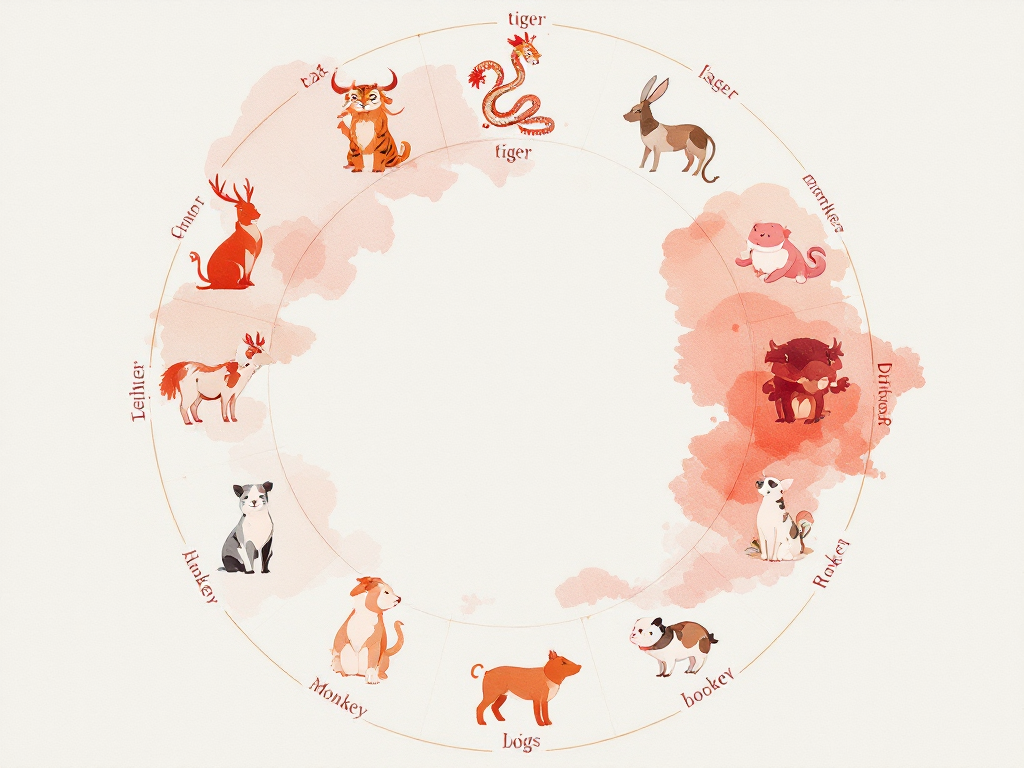
- 12 earthly branches are the 12 animals of the Chinese zodiac (Rat, Ox, Tiger, Rabbit, Dragon, Snake, Horse, Goat, Monkey, Rooster, Dog, Pig).
A stem and branch form an “element + animal” pair. Four such pairs make the eight characters of your Ba Zi chart.
How does it differ from European astrology?
The two systems use different frames of reference. A few key differences:
| Feature | European astrology | Ba Zi |
|---|---|---|
| What is observed | Positions of celestial bodies | Date and hour in the solar calendar |
| Basic units | 12 signs, 10 planets, 12 houses | 5 elements, 12 branches, 4 pillars |
| Key point | Ascendant / Sun | Day Master |
| Calendar | Gregorian / tropical zodiac | Solar calendar; year begins at Lichun (around February 4) |
| Focus | Psychological portrait, transits | Elemental balance, luck periods |
This is not “one is more correct than the other.” These are two different systems, developed in different cultures for somewhat different purposes. Ba Zi traditionally emphasizes long-term periods and elemental balance, while European astrology places more emphasis on a psychological portrait and current transits.
History: from the Song dynasty to today
Ancient foundations: Huang Di and the I Ching
The roots of Ba Zi go back to the legendary Yellow Emperor (Huang Di) and the I Ching (Book of Changes), which took shape around the first millennium BCE. The concepts of yin and yang, the five elements of Wu Xing and the sexagesimal cycle are the heritage of this era.
Tang dynasty: early forms (7th–9th centuries)
The first documented methods of interpreting fate from a birth date appeared in the Tang era. They are associated with the name of Li Xuzhong (李虛中, 9th century) - a master who introduced the practice of reading fate according to three pillars: year, month and day. This was still “San Zhu” (Three Pillars), not Ba Zi.
Song dynasty: the Ba Zi canon (10th–13th centuries)
Ba Zi acquired its modern form during the Song Dynasty. The key figure is Xu Ziping (徐子平, 10th–11th centuries). He added a fourth pillar, the birth hour, and made the Day Master, rather than the birth year, the center of the chart. This reform consolidated the system in the form in which it has existed for more than a thousand years.
The treatise Ziping Zhenquan (True Canon of Ziping) and later works such as Ditian Sui (Drop of Heavenly Mysteries) formed Ba Zi’s theoretical core.
To understand a person’s fate, it is not enough to know the year of his birth. One must know the four pillars - year, month, day and hour - and read them in relation to the Day Master.
Ming and Qing dynasties: professional practice
By the 15th–19th centuries, Ba Zi became part of the educated class’s studies. Officials, doctors and feng shui masters studied the basics of Ba Zi. Schools and commentaries emerged all over China. During this period, the system was enriched with detailed methods of “major luck periods” (Da Yun) and “annual periods”.
20th–21st centuries: globalization
After the Cultural Revolution, Ba Zi persisted in Hong Kong, Taiwan and the Chinese diaspora in Southeast Asia. Since the 1990s, the system gradually returned to mainland China and is actively studied in the United States and Europe as one of the largest classical astrological traditions in the world.
How it works: Four Pillars and five elements
Four Pillars (Si Zhu, 四柱)
- Year pillar. The first visible layer. Usually describes the early period of life (up to ~16 years), relationships with ancestors and a shared “family root.” This is where the “Year of the Dragon” or “Year of the Rabbit” comes in popular horoscopes.
- Month pillar. Describes your parents, the environment in which you grew up, and the general social context of 17–32 years. Very important - it determines the “season” of your chart.
- Day pillar. The most important pillar. The heavenly stem of the day is the Day Master, your essence. The earthly branch of the day is usually about a spouse/partner and personal intimacy.
- Hour pillar. Describes talents, children, fruits of labor, later stages of life (after ~48 years).
Five Elements (Wu Xing, 五行)
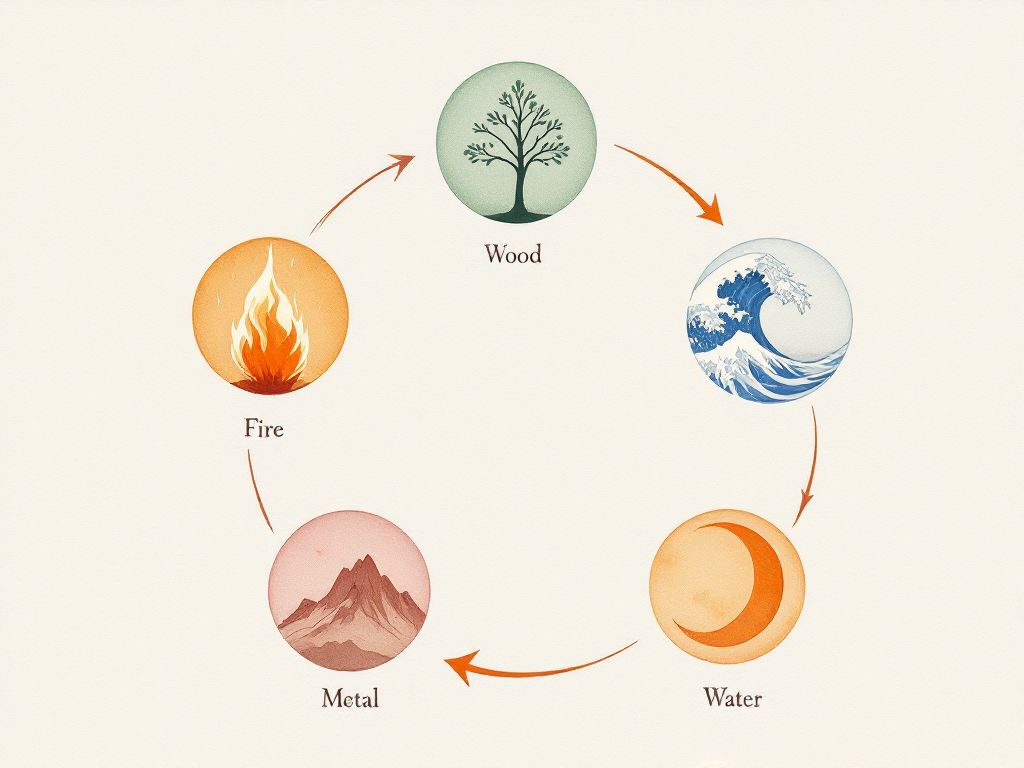
In Ba Zi, the five elements are connected by two key cycles:
Cycle of generation (sheng): Wood → Fire → Earth → Metal → Water → Wood.
Wood fuels Fire; Fire burns and leaves ash, which becomes Earth; Earth contains Metal (ore); melted Metal is associated with Water; Water nourishes Wood.
Controlling cycle (ke): Wood → Earth → Water → Fire → Metal → Wood.
Wood’s roots penetrate Earth; Earth absorbs Water; Water extinguishes Fire; Fire melts Metal; Metal cuts Wood.
Within this framework, a strong Ba Zi chart has balanced elements, while another chart may show some elements in excess and others in short supply. The practitioner’s task is to find a useful element (what the chart lacks or what supports the Day Master) and rely on it.
Yin and yang
Each element exists in two polarities:
- Yang (光) - active, obvious, outward-directed side.
- Yin (陰) - passive, hidden, inward-directed side.
For example, the Yang Wood is a “strong tree”, a large trunk, a strong pine. Yin Wood is a “flexible plant”, a vine, a bamboo, a flower. The quality is the same (Wood), but manifests itself in different forms.
The Day Master is always given a specific combination: “Yang Fire Tiger,” “Yin Water Rabbit,” “Yang Metal Dragon”. This is the first combination a Ba Zi practitioner identifies in a chart.
Sexagenary cycle
12 branches × 5 elements = 60 unique pairs. This Jia Zi cycle is the basic rhythm of the Chinese calendar. Ba Zi is not the only practice that uses this cycle: it is used in traditional medicine, feng shui, choosing favorable dates and traditional chronology.
The year according to the Chinese solar calendar begins on “Lichun” - around February 4. This is important: a child born on January 20, 1990, according to Ba Zi, belongs to the year of the Horse (1989), and not to the year of the Goat (1990). Many independent calculations give an error precisely at this point.
What does a Ba Zi chart show you?
A complete Ba Zi chart has several layers. The three levels you get first are:
1. The Day Master: your core quality
The Day Master is a brief description of a person’s “nature”. For example:
- Yang Fire (Bing) - sunny, open, warm, leadership energy. Likes to be seen, does not tolerate isolation well.
- Yin Water (Gui) - soft, flowing, penetrating. Adaptive, but requires internal support.
- Yang Metal (Geng) - structured, hard, straight. Strong will, tendency to be tough.
This is not a fixed lifelong character profile, but a baseline quality of your energy.
2. Balance of elements
The chart shows which of the five elements you have in abundance and which are in short supply. Based on this, the practitioner identifies the “useful element” - that which strengthens your chart.
Further, this information can be applied very practically: colors in clothes, directions for office and home, types of activities (professions associated with Wood - education, growth; with Fire - publicity, art; with Earth - real estate, care; with Metal - technology, weapons, law; with Water - travel, finance, communications).
3. Major periods (Da Yun)
Every 10 years, you enter a new “major period” - a “heavenly stem + earthly branch” pair that overlays the birth chart. These periods give a long-term forecast: which decades of life are more favorable for which activities, and which ones are about laying the foundation.
This is one of Ba Zi’s main strengths as a practical tool. European astrology also knows how to work with long cycles (through progressions, transits of the outer planets), but in Ba Zi, periods of 10 years are a built-in part of the chart.
If you are just getting acquainted with Ba Zi, start with three things: the Day Master, the dominant element in the chart and the current major period. This is already enough to get a meaningful portrait.
What Ba Zi does not do
To use the system responsibly, keep its limits in mind.
- Ba Zi does not predict specific events with a date. Its forecasts use probabilistic language: “the period is favorable for...”, “there is a risk...”, “attention to...”.
- Ba Zi does not diagnose health. In the classics there are connections between elements and organs, but these are symbolic correspondences. Medical diagnoses belong to doctors.
- Ba Zi does not strictly define the “compatibility” of partners. Charts can harmonize or conflict at the level of elements, but real relationships are about real communication, not about columns of hieroglyphs.
- Ba Zi does not work without an exact date and preferably the time of birth. If the hour of birth is unknown, the fourth pillar will be uncertain, and this must be understood in advance.
Ba Zi on astronavi
On astronavi, the Ba Zi calculation is based on the classical method of Xu Ziping: solar calendar with the year changing at Lichun, four pillars, Day Master, Wu Xing balance and major periods. This is more than a “Year of the Dragon horoscope for next week” - we provide a complete chart.
The service will tell you about your Day Master in warm human language, show which elements the chart emphasizes or lacks, and highlight the current 10-year period. This is not magic or a fixed verdict - it is a structured framework for thinking about yourself and your long-term plans. To build your chart, go to the Ba Zi section and fill in the date, time and place of birth. The more accurate the hour, the more complete the chart.
Questions and answers
How does Ba Zi differ from the usual Chinese “year horoscope”?+
A year horoscope, such as the Year of the Tiger or Rabbit, uses only one of the four pillars: the year. Ba Zi uses all four—year, month, day and hour of birth. Each pillar pairs an animal with an element, making eight characters in total; “Ba Zi” means “eight characters.”
Why does the exact birth hour matter?+
Without the birth hour, the fourth pillar is missing. The chart can still be used, but it offers less detail about talents, children and later life stages. When the hour is unknown, many practitioners use 12:00 as a neutral placeholder and warn that the result is approximate.
What is the Day Master, and why does it matter most?+
The Day Master (日主, ri zhu) is the heavenly stem of the birth day. In Ba Zi it is treated as your “core nature”; the rest of the chart is read in relation to it—what supports it, drains it or conflicts with it. It is the chart’s central reference point.
Why does Ba Zi not use planets as European astrology does?+
The systems use different foundations. European astrology considers the Sun, Moon and planets in the zodiac. Ba Zi uses a solar calendar, heavenly stems, earthly branches and the five Wu Xing elements. Instead of “Mercury in Aries,” it might describe “Yin Fire in Rabbit.”
How does the 60-year cycle relate to 12 animals and five elements?+
The 12 animals and five elements combine in pairs: 12 × 5 = 60 combinations. This Jia Zi cycle is a basic rhythm of the Chinese calendar, used in Ba Zi as well as traditional medicine and feng shui.
Can Ba Zi identify the best career or partner for me?+
A Ba Zi chart describes tendencies and stronger elements. Practitioners use these to suggest suitable fields of work or possible compatibility. These are probabilistic prompts, not fixed verdicts; the choice remains yours.
Does the Ba Zi year start on January 1 or at Chinese New Year?+
Neither. In Ba Zi the year changes at Lichun, the start of spring in the solar calendar, usually around February 4. People born in January or early February may therefore belong to the preceding Ba Zi year rather than their Gregorian birth year.
Ready to try Ba Zi for yourself?
Open this area in your dashboard for a reading based on your details.