Ask the Universe: a metaphorical image as a reflection tool
An image-answer is a metaphor for reflection, not a yes-or-no prediction. Explore the history of seeking answers through signs, from Delphi and the I Ching to Jung, and learn when a metaphor helps or hinders.
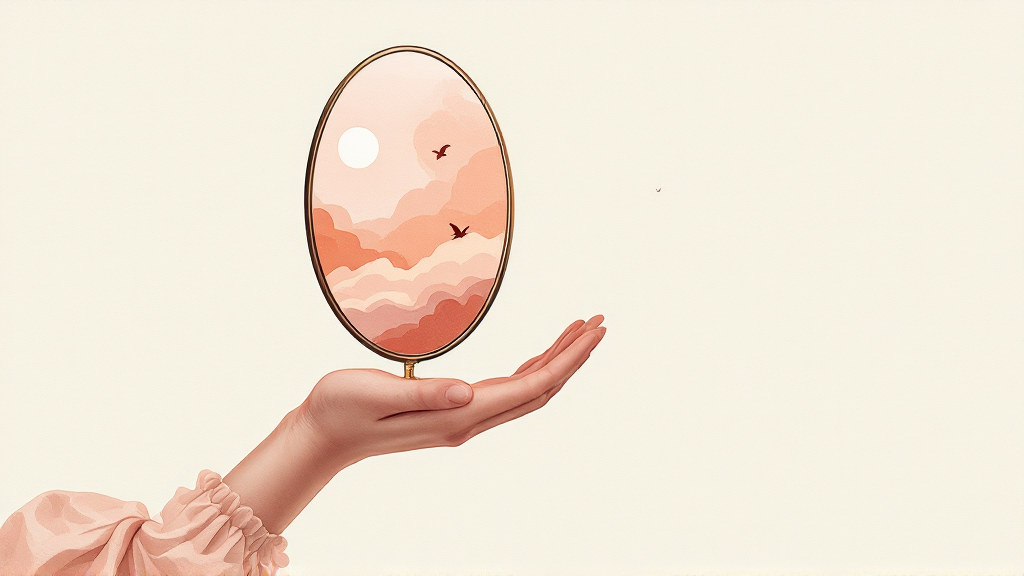
When your thoughts are tangled, sometimes what you need is not advice or a plan, but a mirror. Rather than “What should I do?”, you might ask, “What do I already know but cannot yet see?” “Ask the Universe” is a short practice in which you ask an open-ended question and receive a metaphorical image in response. It will not say “yes,” “no,” or “in 3 months.” It may be a picture or phrase that gives you a fresh perspective on your situation. Here we explore the practice, its surprisingly long history, and its limits.
What is an image-answer?
Ask the Universe is a reflective practice that works like this:
- You formulate an open question. Not “should I buy an apartment,” but “what do I really want in this situation?”
- You receive a metaphorical image: a picture, a short phrase, a symbol.
- The image becomes a prompt for reflection: what does it evoke? What echoes your situation? What do you not like about it, and why exactly?
- You write 3–5 sentences in your journal and close the session.
What this practice doesn't do:
- It does not answer “yes” or “no”; the image is too open to interpretation.
- Does not predict events - it is not an oracle that forecasts the future.
- Does not replace specific knowledge: financial, legal, medical.
- It does not “know” you - it only gives a random or pseudorandom image to which you bring your own meaning.
What this practice does:
- Creates distance between you and your situation. When you look at a situation through the image of a tree, a bridge or a closed door, you may find it easier to see from another angle.
- Activates associative thinking. Logic can repeat familiar arguments; a metaphor opens another route.
- Gives you a reason to write. The habit of asking a question and reflecting in writing can matter more than any single image.
The most valuable thing in practice is not the image you receive, but your reaction to it. “I don’t like it” - why? “It resonates” - in what way? This reaction is the real answer. The universe (or the interface) helped you put it into words.
A history of seeking answers: from Delphi to Jung
The idea of “receiving an answer through a sign” is older than any modern esotericism. Across cultures, people have used signs to think through questions. Here are several milestones:
Delphic Oracle (8th century BCE–4th century CE)
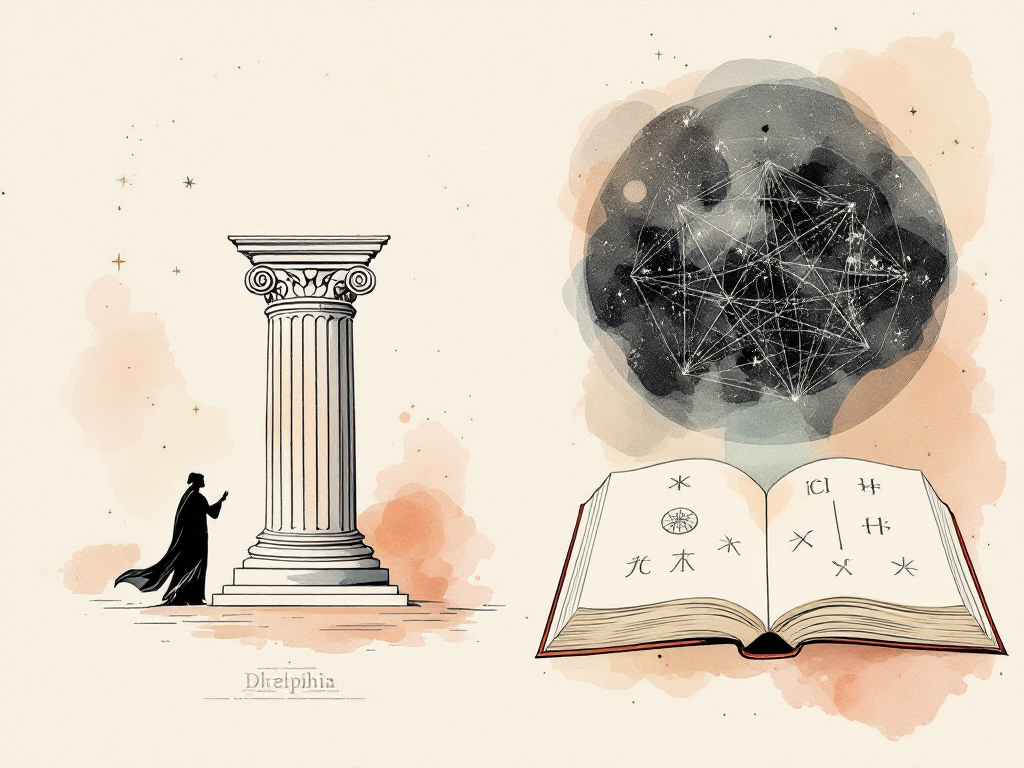
In the Temple of Apollo at Delphi, Pythia was the priestess who, in a trance, gave answers to the questions of pilgrims. The answers were famous for their ambiguity: the classic example concerns King Croesus, who was told that starting a war would “destroy a great kingdom.” Croesus assumed the kingdom was Persia, but lost the war and destroyed his own. The phrase “Know Thyself” (γνῶθι σεαυτόν) was inscribed at the temple. This is the key to understanding the practice: the response could serve as a reason to examine oneself, not straightforward information.
The Book of Changes — I Ching (c. 8th century BCE, China)
One of the oldest texts in the world. 64 hexagrams (combinations of six solid or broken lines) describe universal situations. A hexagram is generated by tossing coins or using yarrow stalks. Each comes with a poetic, metaphorical commentary that invites interpretation. The I Ching does not offer a direct answer: it gives a picture in which you need to recognize your own situation.
Opening sacred texts by lot (sortes biblicae, 4th–15th centuries)
In medieval Europe, the practice of sortes (from the Latin sortes - lot) was widespread. Someone opened the Bible (or Virgil, or Homer) in a random place and read the first phrase he came across as the answer to his question. This is the so-called bibliomancy. The Church had an ambivalent attitude towards the practice: it formally condemned it, but many saints and monks used it. St. Augustine in his Confessions describes how he made a life choice by randomly opening an epistle of the Apostle Paul.
Different cultures have their own versions of bibliomancy: divination with Hafiz’s Divan in Iran, with the Aeneid in Rome (sortes Vergilianae), from collections of poetry in China.
Jung and synchronicity (1920s–1950s)
In the 20th century, a psychological interpretation was added to this long tradition. Carl Gustav Jung introduced the concept of synchronicity - a “meaningful coincidence” when an external event reflects a person’s internal state without a cause-and-effect relationship. In the preface to the English edition of the I Ching (1949), Jung explicitly wrote: the book works not because it “knows the future,” but because a chance sign prompts a meaningful interpretation in the mind of the reader. The reader may then recognize that interpretation as an answer, but the meaning comes from the reader.
To understand what is going on in the I Ching, we need to discard some of the preconceptions of the Western mind. The book does not pretend to have causal knowledge - it claims to have meaning, and this meaning is born in the meeting between the text and the reader.
This offers a framework for a modern image-answer practice. You receive a random sign, and the moment you meet it, you may recognize an interpretation that was already taking shape in you. The sign is a catalyst, not the source of meaning.
Modern question-focused journaling
In the 21st century, the practice has found another form: reflective journaling techniques have spread (Julia Cameron - “Morning Pages”, Tim Ferriss, Cameron Spalding, etc.), where the central technique is formulating one open-ended question at the beginning of the day and writing a response to it. “Ask the Universe” is a lighter version of that approach: you ask a question, and an image arrives “from outside” to help you get past a blank page.
How it works: metaphor as another route
Why can a metaphor help when a direct question leaves you stuck? Several practical explanations do not require mysticism.
1. Metaphor interrupts habitual thinking
When you think about the same situation for a month, your thoughts tend to follow the same paths. You already know your usual arguments. A metaphor (“closed door,” “deep-rooted tree,” “bridge in the fog”) introduces a new context in which the same situation looks different. This is a technique used by psychotherapists, coaches and narrative practitioners.
2. Imagery engages a different mode of thinking
In a simplified model, the left hemisphere is associated with linear, verbal processing and the right with more visual, holistic processing. When you receive a picture and not text, you may briefly shift how you process the question. In this mode, connections that did not form in linear thinking may become visible.
3. Metaphor eases pressure to answer directly
The direct question “Am I living the right way?” is too difficult to answer honestly. The question “What does an old tree bring to mind about my life?” is easier. A buffer appears between you and the topic. That distance may let you acknowledge something you have struggled to say directly.
4. Randomness eases the pressure to find the “right answer”
When you draw a random card or open a random page, you do not have to choose the “correct” answer; an image simply appears. This small shift reduces perfectionist anxiety and allows you to work with what you have.

What “Ask the Universe” shows you
If used regularly, the practice does four specific things:
- Clearer questions. Half of the benefit is that you are forced to turn the vague “Something feels off” into a specific “What do I want to understand?” The wording itself often already shifts something.
- Archive of reactions. If you write down 3 sentences after each session, after 3 months you will have 30+ notes. This is material in which you can see recurring themes - things that you wouldn't notice on your own.
- A moment to pause. When thoughts are spinning, the image is a micro-pause. A minute in which you do not “decide”, but “look”. This minute is often enough to soften a spiral of anxious thoughts.
- Access to what is already known. You may already have many answers to personal questions. Metaphor is a way to extract them.
When practice is especially useful
- When your thoughts are tangled. There are too many factors, there is no clarity where to start.
- Before a difficult conversation. Clarify what you really want from the conversation.
- In moments of burnout. When “something needs to be changed,” but it’s not clear what exactly.
- During a period of transition. The end of a project, a move, a divorce, a new job - times when it is useful to hear yourself.
- As a morning or evening ritual. One open-ended question a day is a gentle habit of introspection.
When the practice is not useful and may cause harm
- Medical questions. “What disease do I have”, “what course of treatment should I take”, “are these symptoms dangerous” - consult a doctor. The metaphor does not work here and is dangerous if it delays care.
- Financial decisions. “Should I buy this apartment”, “should I invest in this asset” - take them to a financial adviser, accountant or lawyer. An image is not financial analysis.
- Legal situations. Divorce, inheritance, conflict with the employer - contact a lawyer. Metaphors cannot tell you how the law applies.
- Relationships with other people that require facts. If you suspect infidelity, violence or fraud, a metaphor is not a source of evidence. You need evidence, gathered through appropriate means.
- Mental crises. Acute anxiety, depression, suicidal thoughts - see a specialist immediately. Contacting a mental health helpline is a practical form of self-care.
If you notice that you are starting to base important life decisions only on “image-answers”, avoiding direct conversation with yourself and the people around you, pause. Any reflective practice should return you to your life, and not draw you away from it.
Myths and limitations
Myth 1: “If I have a good question, an accurate answer will come.” No. The image will always be random. Any sense that it is “accurate” comes from your interpretation. If you need an exact answer, this is not the right practice. This is a practice for open questions that do not have a ready-made solution.
Myth 2: “You can ask the same question dozens of times until you get the ‘right’ answer.” This is counterproductive. If you pull out images until you get one that confirms your desire, you are using the practice not as a mirror, but as a way to deceive yourself. Ask once, record your reaction, and end the session.
Myth 3: “It only works with the “right” attitude.” No special preparation is needed. A quiet place, a minute of attention, an open question. Candles, crystals and rituals do not make the practice more effective; they may make it more pleasing to you, without changing what the practice does.
Myth 4: “This is a conversation with higher powers.” If that is your spiritual understanding, you are free to hold it. But in a neutral presentation, “Ask the Universe” is a dialogue with yourself through an image. Any interpretation is born in your head.
In astronavi “Ask the Universe” works simply: you formulate an open question, receive one metaphorical image and a short interpretation in our tone (without “luck awaits you”). Then notice what resonates, write a couple of sentences in your diary, close the session. In a month, you will have a personal archive of observations about yourself, which in itself is more valuable than any single “answer.”
If your day began in confusion and you need to start somewhere, open the Ask the Universe section, ask a question and see what image answers you. Use it to see your thoughts a little more clearly.
Questions and answers
What is Ask the Universe?+
It is a reflection practice: ask an open question and receive a metaphorical image rather than a “yes” or “no.” The image can help you view your situation from another angle. It is a mirror for thought, not a prediction.
Does it predict the future?+
No. An image-answer does not say what will happen. It offers a metaphor that lets you see your situation in a new context. Its meaning comes from your interpretation rather than from the image alone.
What questions can I ask?+
Ask open questions such as “What am I missing here?”, “What do I really want?”, “What is the focus now?” or “What matters before this conversation?” Closed yes-or-no questions, precise “how much” or “when” questions, and medical, legal or financial questions are unsuitable.
Can I ask about health or money?+
It is better not to. Consult a doctor about health, a financial adviser about finances and a lawyer about legal matters. A metaphor cannot replace specific expertise, and relying on it may dangerously delay seeking help.
Where did the idea of seeking answers through images come from?+
It has a long history: the Delphic Oracle in Greece from the 8th century BCE, the roughly 2,800-year-old I Ching in China, and medieval European bibliomancy with the Bible and other books (sortes biblicae). In the 20th century, Carl Jung offered a psychological interpretation through synchronicity.
Can I ask the same question several times?+
It is better not to. Drawing images until you get the answer you want only confirms a decision you have already made. Ask one question per session, write down your reaction, then stop.
Do I need to prepare for the practice?+
No. A quiet place and a minute of attention are enough. Candles, crystals and rituals are optional aesthetics, not requirements. What matters is an honestly worded question and a willingness to record your response to the image.
Ready to try Ask the universe for yourself?
Open this area in your dashboard for a reading based on your details.